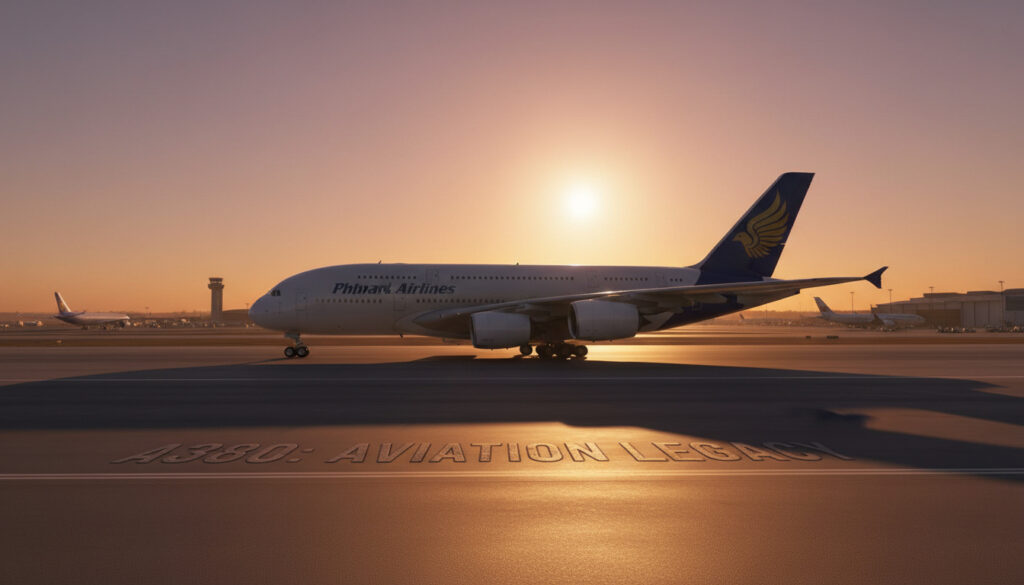
Airbus A380-800 – Specifications History Operators Retirement
The Airbus A380-800 stands as aviation history’s largest passenger aircraft, featuring a full-length double-deck fuselage that redefined airborne capacity before economic realities grounded production. Despite carrying up to 853 passengers in certified configurations and completing over 800,000 flights since its 2007 service entry, the fleet encountered accelerated retirements after 2020 as airlines pivoted toward fuel-efficient twinjets. Today, barely a handful of operators maintain active passenger services while converted freighters handle select cargo routes.
Development of this superjumbo demanded unprecedented engineering coordination across 1,500 companies in 30 countries, utilizing 19,000 fuselage bolts and advanced wing designs optimized for efficiency. The resulting aircraft spans nearly 80 meters in wingspan and requires approximately 300 meters less runway for takeoff than competing large aircraft, according to Airbus technical documentation. Yet technical achievement failed to secure commercial longevity.
Production ceased in mid-2021 after manufacturing 254 units, a fraction of the 1,200-plus originally projected, with cumulative losses exceeding €25 billion for the manufacturer. By 2024, most global airlines had removed the type from scheduled passenger service amid shifting route economics and post-pandemic fleet rationalization.
What are the key specifications of the Airbus A380-800?
Engineers designed the A380-800 around extreme scale while maintaining operational compatibility with existing airport infrastructure. The aircraft measures 72.72 meters in length and stretches 79.75 meters from wingtip to wingtip, creating a wing area of 845 square meters that generates substantial lift efficiency.
72.72 m
79.75 m
853
15,200 km
Key characteristics defining the type include:
- Double-deck configuration providing floor space equivalent to three tennis courts
- Maximum takeoff weight of 575 tonnes distributed across 22 wheels
- Cruising speed of Mach 0.85 (903–945 km/h) at service ceilings up to 13,136 meters
- Approach speeds matching the single-aisle A320 despite dimensional disparities
- Four-engine options: Rolls-Royce Trent 900 or Engine Alliance GP7200
- Commercial EIS (Entry Into Service) October 2007 with Singapore Airlines
- Production total of 254 units before program termination in 2021
| Category | Specification | Value |
|---|---|---|
| Length | Overall | 72.72 m |
| Wingspan | Overall | 79.75 m |
| Height | Overall | 24.1 m |
| Wing Area | Total surface | 845 m² |
| Max Certified Capacity | All-economy layout | 853 passengers |
| Typical Capacity | 4-class configuration | 469–525 passengers |
| Range | Maximum capability | 14,800–15,400 km |
| Engines | Available options | Trent 900 / GP7200 |
| Maximum Takeoff Weight | Certified limit | 575 tonnes |
| Cabin Width | Main/Upper deck | 6.5 m / 5.8 m |
| First Flight | Prototype | April 27, 2005 |
How many A380-800 were produced and what is its history?
When did development begin and first flight occur?
Airbus conceptualized the A380 during the 1990s as a response to anticipated demand for high-capacity hub-to-hub transportation. The prototype achieved first flight on , following extensive wind tunnel testing and systems integration across European manufacturing facilities.
What production volumes materialized?
Manufacturing concluded in mid-2021 after delivering 254 aircraft, according to Airbus official documentation. This figure represents approximately 25 percent of initial sales projections that envisioned 1,200-plus units. Assembly involved specialized transport logistics for major components, including fuselage sections moved by sea and air to Toulouse.
Final delivery occurred during mid-2021, marking the end of a production run that lasted from 2004 through 2021. The manufacturing process involved 1,500 companies across 30 countries contributing to the final assembly.
Why did Airbus discontinue the program?
Commercial discontinuation resulted from insufficient hub-to-hub passenger demand, per-seat operating costs 20–30 percent higher than modern twinjets, and airline preferences for fleet flexibility. Following the global aviation downturn after 2020, carriers including Air France and Lufthansa accelerated retirement timelines originally projected for the late 2020s, as detailed by aerospace industry analysis.
What about secondary markets and conversions?
Limited freighter conversion programs emerged post-retirement. IAG Cargo currently operates modified units carrying 13.2 tonnes across specialized pallet configurations, utilizing the volumetric capacity that made the passenger variant distinctive.
Which airlines currently operate the Airbus A380-800?
Passenger operations in 2024
By 2024, active passenger fleets had contracted significantly from peak deployment. British Airways maintains 12 aircraft configured for 469 passengers across four classes, representing one of the few remaining European operators.
Emirates historically operated the largest global fleet, exceeding 100 aircraft at peak capacity, though the Dubai-based carrier accelerated phase-out schedules by 2024 amid fleet modernization with smaller long-range alternatives. Most Asian and European legacy carriers completed withdrawals between 2020 and 2023.
Cargo and specialized services
IAG Cargo employs 12 converted A380-800 freighters, utilizing the double-deck volume for high-density freight on long-haul sectors. These aircraft accommodate 4 AKE plus 4 PAG pallets with compatible ULD configurations, repurposing airframes otherwise destined for storage or part-out.
How does the A380-800 compare to the Boeing 747?
While both represent quad-engine widebody categories, the A380-800 offered substantially greater floor space through its full double-deck design versus the 747’s partial upper deck. However, the Boeing platform achieved superior commercial longevity with over 1,500 units produced across all variants compared to the A380’s 254-unit production run.
The A380 prioritized maximum passenger capacity over route flexibility, requiring specific gate configurations and ground infrastructure. The 747 maintained operational versatility across diverse airport types, contributing to its extended production timeline and freighter market dominance.
Range capabilities prove roughly comparable, with the A380 offering 15,000 kilometers maximum against the 747-8’s approximately 14,800 kilometers. However, the Boeing’s twin-engine successors ultimately captured the market segment Airbus targeted with the superjumbo, as referenced in technical comparison studies.
The A380 program accumulated losses exceeding €25 billion despite technical achievements, while the 747 family remained profitable across passenger and cargo variants for over five decades, illustrating the market penalty for capacity-over-flexibility designs.
What is the complete timeline of A380-800 development and service?
- 2000: Program launch and firm commitment to development
- 2005: First flight achieved on April 27 with prototype aircraft
- 2007: Entry into service with Singapore Airlines launching commercial operations
- 2010s: Peak operational period with multiple global airlines operating extensive fleets
- 2019: Airbus announces production termination due to insufficient order backlog
- 2021: Final delivery completed mid-year, concluding manufacturing at 254 units
- 2020–2024: Accelerated retirements across major airlines amid pandemic restructuring and fuel cost pressures
- 2024: Minimal active passenger fleets remain; freighter conversions sustain limited operational relevance
Cumulative operational statistics compiled by aviation data aggregators indicate the fleet transported over 300 million passengers across more than 800,000 flights prior to mass retirements.
What facts are established versus what remains uncertain?
Established Facts
- Total production: 254 units delivered between 2007–2021
- Maximum certified capacity: 853 passengers
- Physical dimensions: 72.72m length, 79.75m wingspan
- Production termination date: Mid-2021
- Engine options: Trent 900 and GP7200 exclusively
Remaining Uncertainties
- Exact number of airframes remaining in flyable storage versus permanent retirement
- Final disposition of specific fleet numbers undergoing part-out versus preservation
- Potential for additional freighter conversions beyond current IAG Cargo operations
- Long-term museum placement for historically significant airframes
Why did the world’s largest airliner fail commercially?
The A380-800 embodies a miscalculation regarding hub-and-spoke network evolution. When development commenced in the 1990s, Airbus strategists anticipated continued consolidation of traffic through major international gateways. Instead, aviation markets fragmented toward point-to-point routes efficiently served by long-range twinjets like the Boeing 787 and Airbus A350.
Operating economics proved decisive. Four-engine fuel consumption and maintenance requirements created per-seat costs substantially above modern alternatives, rendering the aircraft uncompetitive on routes below maximum density. Safety incidents affecting industry confidence in large fleet transitions compounded economic pressures during the 2020s restructuring.
Furthermore, airport infrastructure requirements limited operational flexibility. The A380-800 requires specific gate configurations, taxiway strength ratings, and spaced parallel runway operations that constrain scheduling options at secondary hubs, forcing reliance on ultra-high-volume trunk routes that failed to materialize in projected quantities.
What do primary sources confirm about the program?
“The A380-Facts-and-Figures documentation confirms 254 deliveries across a production span utilizing 1,500 companies and 30 countries, with wing systems optimized through advanced aerodynamic design.”
— Airbus Technical Documentation, December 2021
“British Airways operates 12 aircraft with 469-passenger capacity in four-class configuration, representing continued commitment to high-density trunk routes while other carriers retire similar equipment.”
— British Airways Fleet Facts
What defines the A380-800 legacy?
The Airbus A380-800 remains aviation’s most ambitious passenger capacity achievement, demonstrating technical mastery through its full double-deck configuration and 575-tonne MTOW while illustrating market risks of betting against network fragmentation. With 254 units built and most passenger operations concluded by 2024, the type transitions toward cargo conversion and museum preservation, securing its place as a singular engineering triumph that arrived after the economic conditions supporting its business case had evaporated. Aviation history records few parallels to such scale combined with such brief commercial relevance.
Frequently asked questions
Is the Airbus A380-800 still flying in 2024?
Limited passenger operations continue with British Airways (12 aircraft) and select other carriers, though most global airlines retired their fleets between 2020–2024. IAG Cargo operates converted freighter variants.
What is the maximum seating capacity of the A380-800?
Certified maximum capacity reaches 853 passengers in all-economy configuration, though typical four-class layouts accommodate 469–525 passengers.
Why did Airbus stop producing the A380-800?
Insufficient order backlog, high per-seat operating costs compared to twinjets, and airline preference for flexible fleet types led to production termination in mid-2021 after 254 units.
How many A380-800 aircraft were built?
Total production reached 254 units manufactured between 2004 and 2021, significantly below original projections exceeding 1,200 aircraft.
What engines power the A380-800?
Operators selected either Rolls-Royce Trent 900 turbofans generating approximately 70,000 lbf thrust or Engine Alliance GP7200 powerplants offering 70,000–81,500 lbf thrust.
Which airline operated the largest A380-800 fleet?
Emirates historically operated the largest fleet with over 100 aircraft at peak capacity, though the airline began accelerated retirements by 2024.
What is the range capability of the A380-800?
Maximum range extends to 14,800–15,400 kilometers (8,000–9,500 nautical miles), enabling nonstop service between city pairs like Hong Kong and New York.
When did the A380-800 first fly?
The prototype achieved first flight on April 27, 2005, following development commencement in the 1990s and entry into service during October 2007.
More related posts
 Euros to Pounds Calculator – Live Rates and Comparisons
 London to Amsterdam Train – Times, Prices and Booking Guide
 Man U vs Liverpool – 2026 Fixture Date Tickets History
 Ji Hyun Celebrities: Who Are Jun Ji-hyun, Ji Hyun Woo & More
 New Century Hall Manchester: Capacity, Events & Visitor Guide
 Fatty Liver Symptoms in Females – What Women Need to Know
 How to Pay Stansted Drop Off: Fees, Penalties & Alternatives
 Air Max TL 2.5 – Features, Prices and Design History
