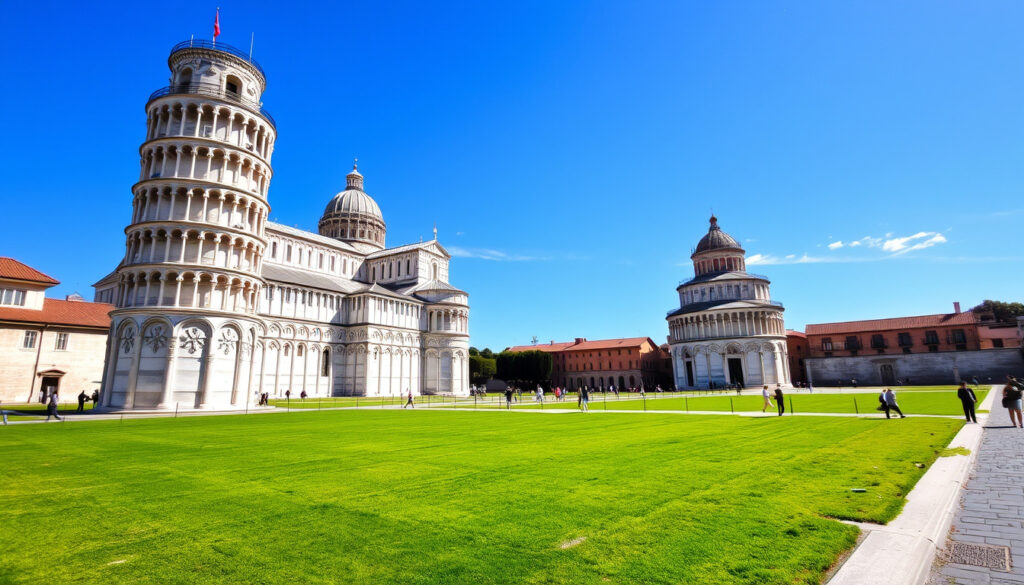
Leaning Tower of Pisa: Why It Leans, Facts & History
You know the photo: someone holding up the Leaning Tower of Pisa like a toy. But behind that playful snapshot lies one of the most ambitious structural rescue missions in modern engineering. Built on marshy ground that started shifting before the third floor was even complete, the tower spent eight centuries slowly tilting toward disaster—until engineers in the 1990s developed an innovative solution that reversed nearly 200 years of lean.
Height: 55.86 meters · Lean angle: nearly four degrees · Weight: 14,700 tons · Construction started: 1173 · Steps to top: nearly 300
Quick snapshot
- Lean caused by soft subsoil and shallow 3-meter foundations (Institution of Civil Engineers)
- Tilt noticeable by second floor during construction in 1173 (Institution of Civil Engineers)
- Stabilized through soil extraction reducing tilt by half a degree (Practical Engineering)
- Exact long-term soil behavior under climate change scenarios
- Whether seasonal groundwater fluctuations will resume affecting tilt
- 1173: Construction begins
- 1372: Construction completes after 200 years
- 1990: Tower closes for stabilization
- 2001: Reopens after £25M, 11-year project
- Continuous monitoring via inclinometers and surveying benchmarks (Geopier Foundation Company)
- No measured movement since 2008 (Geopier Foundation Company)
| Attribute | Value |
|---|---|
| Location | Pisa, Italy |
| Type | Freestanding bell tower |
| Height (higher side) | 55.86 meters |
| Lean | Nearly four degrees |
| Weight | 14,700 tons |
| Construction period | 1173–1372 |
What is causing the Leaning Tower of Pisa to lean?
The Leaning Tower of Pisa tilts because it was built on the wrong ground. Its name itself hints at the problem: Pisa means marshy land in Italian, reflecting the soft, unstable alluvial soil beneath the Square of Miracles. Construction began in 1173, and workers noticed the tilt almost immediately—by the time they reached the second floor, the structure was already leaning. The tower continued tilting throughout its nearly 200-year construction period, eventually reaching a 5.5-degree angle that places the top approximately 15 feet off-center from the base.
The immediate cause was the foundation: just 3 meters deep, resting on layers of clay, sand, and silt that could not support the weight of the marble structure. The Institution of Civil Engineers notes that this shallow foundation meant the tower’s massive weight pressed directly into soft subsoil, which compressed unevenly and allowed the northern side to sink.
The tower’s designers attempted to compensate. Engineers built the upper floors with one side shorter than the other, creating a curved structure in addition to the tilt. This architectural workaround allowed construction to continue despite the growing lean, though the structure never achieved the straight vertical its builders originally intended.
By 1817, when the first recorded measurement was taken, the inclination had reached about 4.9 degrees. The tower continued tilting approximately 2 millimeters per year until stabilization efforts began near the turn of the 21st century, according to Geopier Foundation Company.
The tower’s lean is not a design flaw—it is a consequence of geology. Builders chose marble from quarries 60 miles away for its durability, but they could not change the marshy ground beneath their feet. Understanding this distinction matters: the tower was never meant to lean, and its current stability is entirely the product of modern intervention.
Subsoil subsidence
The underlying clay and sand composition creates a particular problem: the water table fluctuates seasonally, rising higher on the north side during rainy winters. This caused the tower to tilt more during winter months, with the Institution of Civil Engineers documenting how groundwater pressure pushed the soft soil outward, exacerbating the lean each year.
This seasonal movement meant the tower was never static—even after centuries, it remained active, tilting incrementally year after year. The instability was not just a historical problem but an ongoing one that engineers would have to address.
Foundation issues
The 3-meter foundation depth was insufficient for the task. The tower weighs approximately 14,700 tons, concentrated on a relatively small footprint. The soil beneath could not bear this load evenly, and differential settlement—the technical term for uneven sinking—became irreversible once compression occurred.
What made remediation so difficult was that the foundation itself sits below the water table, meaning any excavation risked causing catastrophic sudden settlement. Engineers could not simply dig deeper or add support below without risking the tower’s collapse.
What are 5 interesting facts about the Leaning Tower of Pisa?
Beyond the famous lean, the Tower of Pisa holds several surprises that most tourists snapping photos never learn. It is not merely a quirky photograph opportunity but a structure with nearly 850 years of history embedded in its tilting walls.
Construction spanned from 1173 to 1372, nearly two centuries interrupted by wars, funding pauses, and political instability. According to UC Berkeley Civil and Environmental Engineering, multiple conflicts with neighboring Florence and Genoa forced work to stop for decades at a time, allowing partial settlement between construction phases without causing collapse.
The tower is not one of the Seven Wonders of the World. This confusion persists despite the Hanging Gardens of Babylon and other Ancient Greek and Egyptian originals being roughly 2,500 years older. The Tower of Pisa is a medieval bell tower, not an ancient wonder—and was never intended as such.
Construction timeline
The timeline breaks into distinct phases: initial construction (1173–1178), abandonment during warfare (1178–1272), resumed work under new architects who tried to correct the lean (1272–1296), and final completion with the belfry (1296–1372). Each period reflects the tower adapting to its growing tilt rather than fighting it.
The first recorded tilt measurement came in 1817, when surveys showed approximately 4.9 degrees. This 4.4-degree gap between construction completion and the first measurement underscores how much movement occurred during nearly 450 years without formal monitoring.
Unique architecture
The tower features seven bells in its belfry, each tuned to different notes, though the lean made installing a proper bell mechanism challenging. The exterior showcases Romanesque style with blind arcades—the decorative columns and arches running up the tower’s height—that influence how the structure appears to shift with viewing angle.
Visitors climbing the 294 steps to the top notice the curved interior staircase, a result of builders adjusting to the lean during construction. The eighth floor, which houses the bells, sits at an angle that would make a modern building engineer wince.
Stabilization efforts
The 1990–2001 stabilization project cost £25 million over 11 years and involved drilling 41 inclined holes beneath the tower’s foundation to remove soil gradually. According to Practical Engineering, this permanent solution reversed the tilt by half a degree, returning the tower to conditions similar to the early 1800s.
The approach was counterintuitive: instead of adding weight or support, engineers removed material from beneath the foundation’s high side. This allowed the tower to settle slightly and reduce its angle of lean.
Can people still walk up the Leaning Tower of Pisa?
Yes, visitors can climb the Leaning Tower of Pisa, though the experience differs from a standard monument visit. The approximately 294-step spiral staircase winds through the tower’s tilted interior, with steps that feel distinctly uneven underfoot. The climb takes most visitors 10 to 15 minutes, depending on crowding and fitness level.
Tickets cost around €20 for adults as of recent years, with reduced rates for children and students. Entry times are staggered to manage the flow of climbers, and visitors must book in advance during peak season. The Opera della Primaziale Pisana, the authority managing the site, enforces strict capacity limits—typically no more than 15 to 20 people inside at once.
The tower reopened in June 2001 after 11 years of closure for stabilization. For nearly a decade, the only way to experience the Leaning Tower was from the ground. The fact that visitors can now climb it again represents the successful outcome of one of the most complex geotechnical engineering projects in heritage conservation.
Climbing details
There is no elevator—the tower’s medieval structure and existing lean make vertical transportation systems impractical. The narrow stairway, carved through the tower’s walls during the 13th and 14th centuries, was designed for monks and maintenance workers, not modern tourist volumes.
The stairs spiral counterclockwise going up and clockwise coming down, a common feature in medieval towers designed to force right-handed attackers to present their sword arms while descending defenders enjoyed the advantage. Whether this was intentional or coincidental in Pisa’s case remains debated among architectural historians.
Tickets and access
Advance booking is strongly recommended, particularly during summer months when queues can stretch for hours at the ticket office. Same-day tickets are difficult to obtain during peak season, and walk-up visitors without reservations may find all time slots filled.
Accessibility presents challenges. The staircase is narrow, with low archways requiring ducking in places, and there are no rest areas inside. Visitors with mobility issues, heart conditions, or claustrophobia may want to reconsider climbing. The tower is not recommended for children under eight years old.
How do they prevent the tower from falling?
Engineers prevented the Leaning Tower’s collapse through two distinct phases: emergency stabilization in the early 1990s and permanent remediation from 2000 to 2001. The urgency was driven by the 1989 collapse of a similar tower in Pavia, Italy, which reminded everyone that leaning medieval towers do sometimes fall.
By 1993, researchers estimated the tower’s factor of safety at 1.07—meaning the underlying soil could withstand only 7 percent more load before catastrophic failure. According to Practical Engineering, this razor-thin margin prompted immediate action while longer-term solutions were developed.
Soil extraction
The permanent solution involved drilling 41 inclined holes beneath the north side of the foundation and removing soil incrementally. Over the course of a year starting in 2000, engineers extracted 38 cubic meters of soil—approximately 70 tonnes—using precision equipment that monitored the tower’s response in real time.
The Institution of Civil Engineers describes how the method required drilling holes at precise angles just beneath the foundation, removing small amounts in controlled sequences, and tracking the tower’s movement after each extraction. Too rapid a removal risked sudden collapse; too slow meant insufficient correction.
The soil extraction reduced the lean by approximately half a degree—roughly 560 arc seconds—effectively reversing time to tilt levels last seen in the early 1800s. At that time, the tower’s likelihood of toppling was far lower because it was shorter and the foundation had not yet experienced decades of progressive settlement.
Counterweights and cables
Before the permanent solution, engineers used temporary measures that bought critical time. In July 1993, they loaded approximately 600 tons of lead ingots on the north side of the tower, constructing a concrete ring around the base that served as a platform for the counterweight.
This approach, documented by Penn State Engineering, reduced the inclination by about one minute of arc and decreased the overturning moment by approximately 10 percent. The lead remained in place until soil extraction could be implemented as the permanent fix.
Additional emergency measures included attaching steel cables at mid-height to prevent sudden toppling during the years when the permanent solution was being designed. These cables, anchored to the surrounding ground, provided a failsafe against collapse while more sophisticated engineering proceeded.
Will the Leaning Tower of Pisa ever fall?
The Leaning Tower of Pisa is more stable today than at any point in its modern history. Since 2008, there has been no measured movement whatsoever, according to Geopier Foundation Company. The stabilization project achieved its goals: reduced lean, controlled groundwater, and continuous monitoring.
The Italian Government convened an international panel of experts to oversee the stabilization, documented by UC Berkeley Civil and Environmental Engineering. This committee evaluated the structure using boreholes, soil testing, scale models, and computer simulations before implementing solutions designed to preserve both the tower’s stability and its architectural character.
The tower will not fall in any foreseeable future scenario. The stabilization addressed the fundamental problem—soil instability—rather than merely managing symptoms. With ongoing monitoring, the structure has transitioned from active crisis to stable heritage site.
Current stability
Modern monitoring systems track the tower’s position continuously using surveying benchmarks and inclinometers. Any movement beyond a few tenths of a millimeter would trigger an immediate engineering review. The systems installed during the stabilization project provide real-time data to heritage authorities.
A drainage system now controls the groundwater fluctuations that previously exacerbated seasonal tilting. By managing water levels beneath and around the foundation, engineers eliminated the primary external factor driving annual movement.
Future risks
Climate change presents a theoretical long-term concern, as altered rainfall patterns could affect groundwater levels in ways the drainage system was not designed to handle. However, no significant movement has been recorded in over 15 years, suggesting the stabilization achieved robust results.
The tower’s attachment to the Catino—a surrounding structure that increases the effective foundation area—provides additional stability that the original builders never intended. This connection was discovered and reinforced during the stabilization work, adding an unintended safety margin to the complex.
Construction timeline
Three distinct phases, one continuous problem: understanding when key events occurred helps explain why the tower leaned and how engineers finally solved the issue.
| Period | Event | Significance |
|---|---|---|
| 1173 | Construction begins | Tower planned as vertical bell tower |
| 1178 | Tilt noticed after third floor | Foundation failure becomes apparent |
| 1272–1296 | Work resumes with lean correction attempts | Architects adapt design to existing tilt |
| 1372 | Construction completes | Final belfry added with existing lean |
| 1817 | First recorded measurement: 4.9 degrees | Documented lean begins formal tracking |
| 1989 | Pavia tower collapses; emergency measures begin | Stabilization urgency increases dramatically |
| 1990 | Tower closed to public | Engineering assessment begins |
| 1993 | 600 tons of lead counterweight installed | Emergency stabilization prevents collapse |
| 2000–2001 | Soil extraction reduces lean by half a degree | Permanent stabilization achieved |
| June 2001 | Tower reopens to public | 11-year project concludes successfully |
| 2008 | No measured movement since | Stabilization confirmed effective |
What stands out from this timeline is how long the problem festered without resolution. Between 1372 and 1990, no systematic attempt was made to address the lean—just adaptation and monitoring. The tower survived not because anyone solved the problem but because settlement slowed and stabilized naturally. The modern intervention changed that.
What experts say
“The tower is now stable and has been for almost two decades. The work that was done in the late 1990s and early 2000s was extraordinarily conservative—they were removing soil in fractions of millimeters, monitoring every millimeter of movement, because the margin for error was so small.”
— Institution of Civil Engineers, analysis of stabilization approach
“The lead counterweight was a temporary measure to buy time. It worked—the tower shifted back almost an inch within days. But the permanent solution required thinking about the soil as the problem, not the tower.”
— Practical Engineering, technical breakdown of stabilization methods
These perspectives highlight a fundamental shift in thinking: medieval builders assumed the tower must be the problem, so they tried to build around the lean. Modern engineers identified the soil as the culprit and targeted the foundation system rather than the structure itself.
For heritage authorities managing the tower today, the lesson is clear. Continuous monitoring matters. The Opera della Primaziale Pisana maintains surveillance systems that track any movement, ensuring that if conditions change, intervention can occur before a crisis develops. The tower’s survival is now an engineering project rather than an architectural accident.
Upsides
- Stabilization permanently reduced lean to early 1800s levels
- No measured movement since 2008
- Continuous monitoring systems detect changes immediately
- Drainage system controls groundwater fluctuations
- Tower reopened to public after 11 years of closure
Downsides
- Climate change could alter groundwater patterns in unpredictable ways
- Foundation remains on unstable soil despite stabilization
- Ongoing maintenance costs for monitoring systems
- Access restrictions limit visitor capacity
Engineers chose to reduce the lean rather than eliminate it entirely. The tower still tilts—visitors notice this immediately when they climb the curved staircase inside. But keeping some lean preserved the structure’s iconic character while ensuring stability. A completely straight tower would not be the Leaning Tower of Pisa.
For visitors planning a trip, the practical implications are straightforward: book tickets in advance, expect a physical climb, and take photos from the Square of Miracles rather than from directly beneath. The experience of standing inside a tilting medieval tower, feeling the uneven steps and slanted floors, provides a visceral connection to the engineering challenge that words alone cannot convey.
The Leaning Tower of Pisa survives because centuries of slow crisis forced a response when it finally came. Without the 1989 Pavia collapse creating urgency, without international expertise focused on the problem, the tower might have continued tilting until gravity won. Instead, it stands today as proof that even the most challenging structural problems yield to patient, methodical engineering.
Related reading: Hanging Gardens of Babylon · Sin Cos Tan Table
The tower’s tilt from 1173 construction on soft soil captivates, with facts, history & visiting guide expanding on stabilization and practical visitor advice.
Frequently asked questions
Is the Leaning Tower of Pisa one of the Seven Wonders of the World?
No. The Seven Wonders of the Ancient World were designated in ancient Greek times and include structures like the Great Pyramid of Giza and the Hanging Gardens of Babylon. The Leaning Tower of Pisa is a medieval bell tower constructed in the 12th–14th centuries, making it roughly 2,000 years younger than the original wonders.
What’s so special about the Tower of Pisa?
The tower’s fame stems from its dramatic lean, which developed during construction and persisted for centuries without resolution. Its survival through eight centuries of geological pressure and historical upheaval, combined with the successful modern stabilization effort, makes it a remarkable example of both architectural persistence and engineering achievement.
What does Pisa mean in Italian?
Pisa means marshy land in Italian, a reference to the soft, waterlogged soil beneath the city. This name predates the tower and reflects the geological challenge that caused its lean. The Geopier Foundation Company notes this etymology underscores how the tower’s instability stems from its location, not its design.
Why was the Leaning Tower of Pisa built?
The tower was built as the bell tower for Pisa Cathedral, serving as a call to worship and a symbol of the city’s wealth and religious devotion during the medieval period. It was never intended as a leaning monument or an engineering experiment—the tilt developed as an unintended consequence of building on unsuitable ground.
Why does the Leaning Tower lean more in winter?
The tower tilts more during winter because seasonal rainfall raises the groundwater table on the north side faster than the south side. The Institution of Civil Engineers explains that higher water pressure on the north side pushes against the soft subsoil, causing additional settlement and increased lean during wet months.
Can the Leaning Tower of Pisa fall?
The tower is not in danger of falling in the foreseeable future. The 1990–2001 stabilization project reduced the lean by half a degree, and there has been no measured movement since 2008. Continuous monitoring systems provide early warning of any changes, and the drainage system controls the groundwater fluctuations that previously caused seasonal movement.
How many steps are there to the top of the Leaning Tower of Pisa?
There are approximately 294 steps to the top of the Leaning Tower of Pisa. The climb is physically demanding, with uneven steps caused by centuries of tilt and a spiral staircase designed for medieval monks rather than modern tourists. Visitors should expect a challenging ascent with low archways requiring ducking in places.
More related posts
 Hotel du Vin Exeter – Location, Reviews and Amenities Guide
 What Does BMW Stand For – Official Meaning and History
 You Were Never Really Here: Worth Watching? Plot & Ending
 Royal Mail Post Office: Services, Locations & Tracking
 Hooligan Hefs: Biography, Tour, Songs & Real Name
 Jack P. Shepherd – Age, Career and Coronation Street Role
 Morgan Gibbs-White Stats – 24/25 Goals, Assists, FPL Data
 Punjab King v Mumbai Indian Scorecard: Head-to-Head & Stat
