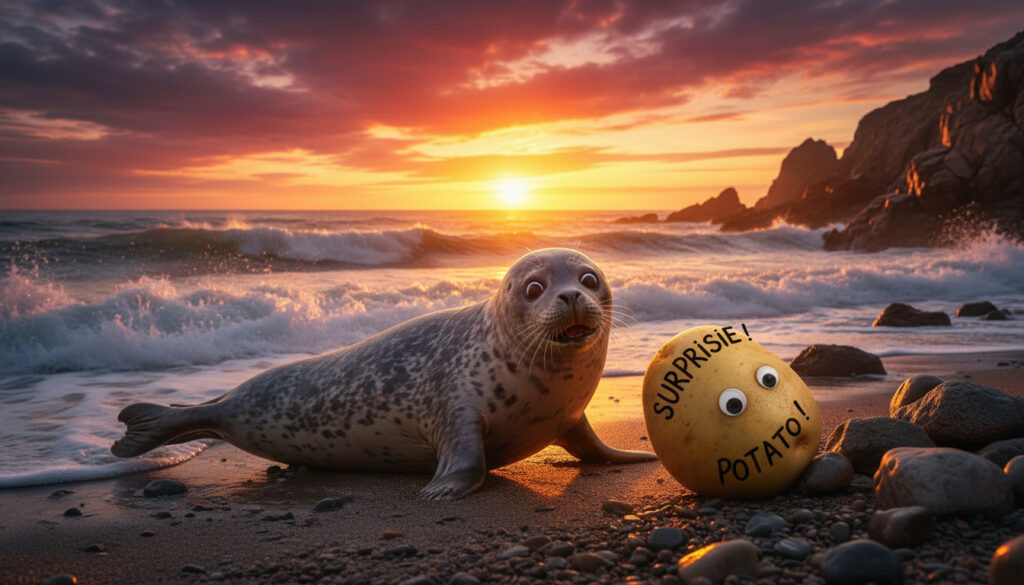
A Seal Pushed Me Yesterday in French – Viral Meme Explained
The phrase “a seal pushed me yesterday” has become an unexpected viral phenomenon across social media platforms, generating millions of views through a linguistic coincidence that makes English speakers do a double-take. When translated into French, the innocent sentence transforms into “Un phoque m’a poussé hier,” a sequence of sounds that phonetically resembles censored English vulgarity when spoken at normal speed. Documentation indicates this meme relies on cross-language phonetic humor rather than any actual inappropriate meaning in the original French.
The trend exploits the French word phoque, meaning seal (the marine mammal), which carries the approximate pronunciation “fok.” Combined with the past tense construction m’a poussé (pushed me) and the temporal marker hier (yesterday), the phrase creates an auditory illusion that has fueled countless reaction videos, translation app screenshots, and voice assistant pranks since early 2024.
Unlike traditional image-based memes, this trend relies entirely on audio delivery and the element of surprise, making it particularly suited to TikTok’s duet and stitch formats where users capture genuine reactions to the phrase.
How do you say ‘a seal pushed me yesterday’ in French?
The direct translation follows standard French grammatical structures while inadvertently creating comedic effect for bilingual listeners.
Key Insights
- The French word phoque translates directly to “seal” and is pronounced roughly like “fok” according to standard dictionaries.
- When combined with m’a poussé (pushed me), the sequence sounds similar to “my pussy” to English ears.
- Voice assistants like Siri and Google Translate amplify the effect when reading the text aloud.
- The phrase emerged from “say this fast” playground pranks adapted for social media environments.
- Variants substitute hier with other phrases like dans la douche (into the shower) for additional comedic scenarios.
- Creators emphasize the humor stems from phonetic coincidence, not cultural mockery of the French language.
- Engagement metrics show high social sharing despite relatively low search volume for the translation itself.
Quick Facts
| Attribute | Detail |
|---|---|
| English Phrase | A seal pushed me yesterday |
| French Translation | Un phoque m’a poussé hier |
| Key Vocabulary | Phoque (seal), m’a poussé (pushed me), hier (yesterday) |
| Approximate Pronunciation | uhn fok ma poo-say ee-air |
| Viral Platforms | TikTok, YouTube Shorts, Instagram Reels, Facebook |
| Meme Category | Phonetic translation humor / “Say this fast” pranks |
What is the original TikTok for ‘a seal pushed me yesterday in French’?
The trend originated not from a single viral video but from a convergence of voice assistant demonstrations and playground-style linguistic pranks adapted for digital platforms. Users began asking Siri and Google Translate to pronounce French words for animals, discovering that phoque created humorous reactions among English-speaking audiences.
From Playground to Platform
The mechanics follow classic “repeat after me” games where unsuspecting participants are tricked into saying something that sounds inappropriate. Early demonstrations show users querying Siri with “How do you say seal in French?” before escalating to the full sentence construction. The format gained traction through TikTok’s duet feature, where one user would speak the phrase while another captured their shocked or laughing reaction.
Amplification Through Formats
Text-on-screen challenges emerged asking viewers to “Repeat after me: Un phoque m’a poussé hier,” followed by reaction shots. Translation app screenshots captioned “French is wild” circulated on Facebook and Instagram, while Google Translate audio clips provided the mechanical pronunciation that maximized the comedic effect.
A related earlier trend involved asking Siri simply “What’s French for seal?” which highlighted phoque in isolation. The full sentence variation emerged later as users sought more elaborate pranks.
How do you pronounce ‘a seal pushed me yesterday’ in French?
Proper French pronunciation creates the very effect that makes the meme work, with specific phonetic qualities that diverge significantly from English expectations.
Phonetic Breakdown
The phrase breaks down phonetically as follows: Un (roughly “uhn”), phoque (“fok,” with a short o sound), m’a (“mah”), poussé (“poo-say”), and hier (“ee-air” or “yair” depending on regional accent). When spoken at normal conversational speed, the boundaries between words blur, creating the illusion of entirely different English phrases. Audio pronunciation guides demonstrate how native speakers naturally run the words together.
The Role of Liaison
French liaison rules, which connect words ending in consonants to those beginning with vowels, contribute to the auditory confusion. The sequence “phoque m’a” flows together in a way that emphasizes the “fok ma” sounds central to the joke’s effectiveness.
What are the lyrics or variations like ‘a seal pushed me into the shower’ in French?
While the original phrase uses hier (yesterday) to complete the temporal scenario, creative users have developed variants that substitute different locations or actions to extend the joke.
“Un phoque m’a poussé dans la douche” replaces “yesterday” with “into the shower,” creating “A seal pushed me into the shower.” This variation maintains the phonetic punch while adding situational absurdity.
Other adaptations include changing the verb or adding adjectives, though the core structure relies on keeping phoque and m’a adjacent to preserve the sound coincidence. Caption formats often begin with “Language lesson:” or “French tutorial:” to lure unsuspecting viewers before delivering the punchline. The viral nature of such unexpected translations draws parallels to other moments of cultural crossover, much like how audiences discover new details about Cast of Manifest (TV Series) – Main Actors and Recasts Explained through online exploration.
This audio-based TikTok trend is unrelated to the “Awkward Moment Seal” image macro that circulated on Reddit and other platforms years earlier. The seal meme family is large, but these specific phrases refer exclusively to the French pronunciation phenomenon.
Viral Timeline
- : Isolated queries asking Siri for the French word for “seal” highlight phoque as a standalone curiosity.
- : The full sentence “Un phoque m’a poussé hier” emerges as structured comment bait and duet content on TikTok, with specific documentation noting the shift to complete phrases.
- : The format spreads to YouTube Shorts and Facebook Reels through translation app screenshots and reaction videos, achieving peak engagement with posts garnering over 139,000 likes on TikTok.
Fact Check: Established vs. Unclear
Established Information
- The translation “Un phoque m’a poussé hier” is grammatically correct French.
- Phoque legitimately and exclusively means “seal” (the marine mammal) in French.
- The meme gained prominence on TikTok between 2023-2024.
- Text-to-speech tools accurately pronounce the phrase as intended by the prank.
What Remains Unclear
- The specific identity of the first creator to use the full sentence format remains unverified.
- Exact view counts for the “original” viral video are disputed across platforms.
- Whether the phrase appeared in informal internet culture prior to the Siri/TikTok era is undocumented.
Why It’s Viral
Cross-language phonetic humor occupies a specific niche in internet culture, appealing to bilingual audiences and language learners who appreciate the accidental nature of the sound coincidence. The meme functions similarly to classic “say this fast” comedy bits where speed of delivery obscures meaning until the listener processes the sounds as English words.
The shock value operates without malicious intent toward French culture; creators consistently frame the joke as a celebration of linguistic quirks rather than mockery. This lighthearted approach, combined with the accessibility of voice assistant technology, has allowed the trend to persist longer than typical flash-in-the-pan memes.
Sources and Documentation
The joke hinges on the French word phoque (seal, pronounced roughly “fok”), combined with m’a poussé (“pushed me,” sounding like “my pussy”) and hier (“yesterday,” rhyming with “here”). English speakers hear it as an accidental vulgarity, amplified by text-to-speech tools like Siri or Google Translate in videos.
Wahup Meme Analysis
It originated as a “say this fast” playground-style prank adapted for TikTok, popularized through Siri/Google queries like “How do you say seal in French?” which reveal phoque’s humorous English sound.
YouTube Documentation
Related Trends
The “seal pushed me” phenomenon represents just one example of how voice assistant technology reveals unexpected intersections between languages. Similar pranks involving Google Translate audio or Siri pronunciations continue to emerge as users discover new phonetic coincidences across French, Spanish, and other languages. For those tracking viral entertainment patterns, keeping up with scheduled programming like Strictly Come Dancing Time Tonight – No Live Show Scheduled offers insight into how internet culture interacts with traditional media schedules.
Frequently Asked Questions
What does “un phoque m’a poussé hier” mean literally?
It literally translates to “a seal pushed me yesterday” in French, using the word phoque for seal (the animal), m’a poussé for pushed me, and hier for yesterday.
Why does the French phrase sound inappropriate to English speakers?
When spoken quickly, phoque sounds like an English swear word beginning with “f,” while m’a poussé resembles “my pussy,” creating an accidental vulgar impression that fuels the comedic effect.
Is this meme related to the Awkward Moment Seal image macro?
No, this is a separate audio-based TikTok trend. The Awkward Moment Seal was a static image meme popular on Reddit years earlier, while this trend relies on spoken French pronunciation.
How did this specific meme originate?
It evolved from earlier Siri demonstrations showing that phoque is French for seal. Users expanded this into full sentence pranks around 2023-2024, leveraging TikTok’s duet and stitch features.
Are there other variations of this phrase?
Yes, popular variants substitute hier (yesterday) with dans la douche (into the shower) or other locations, maintaining the core sound structure while changing the scenario.
Is the translation grammatically correct?
Yes, “Un phoque m’a poussé hier” follows proper French grammar. The verb pousser (to push) conjugates correctly in the passé composé tense with the auxiliary verb avoir.
Why do voice assistants make it funnier?
Siri and Google Translate provide consistent, mechanical pronunciations that emphasize the phonetic coincidence without the natural variations of human speech, making the effect clearer and more repeatable.
More related posts
 What Is a Pronoun – Definition, Types and Examples
 Iran Supreme Leader: Powers, History, Succession (2026)
 Air India Plane Crashes – Timeline of Major Disasters
 Harris Andrews: Age, Achievements, Career Highlights
 How Many Steps a Day – Optimal Targets by Age and Goals
 Cod Black Ops 6 – Release Date Price System Requirements
 Manchester Oxford Road Station: Platforms, Routes & Remodelling
 Sony ZV-E10: Vlog Camera Review vs ZV-E10 II
