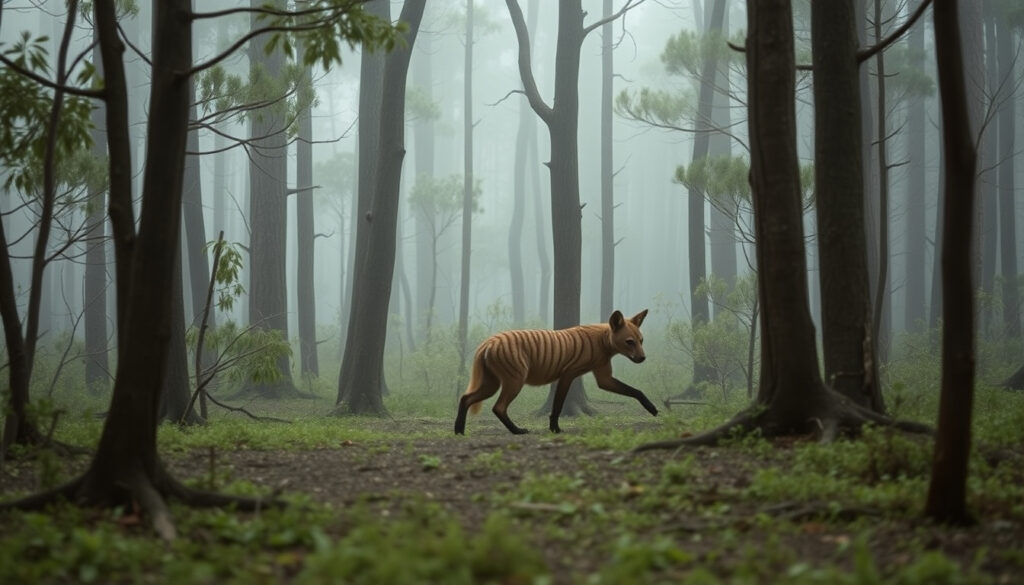
Tasmanian Tiger Extinction: Evidence & 2026 Update
For nearly a century, scientists have treated the thylacine as a lost species, yet every few years a blurry photo or a hiker’s story reignites the question: could it still be out there? By 2026, the tension between hard evidence and hopeful speculation has only grown sharper — and a major biotech project is betting it can bring the animal back before nature does.
Scientific name: Thylacinus cynocephalus ·
Year declared extinct: 1936 ·
Last known died: 1936 (Hobart Zoo, Tasmania) ·
Estimated population at European colonization: 5,000 ·
Known common name: Tasmanian tiger / thylacine ·
Exact time since last confirmed sighting: Over 88 years (2026)
Quick snapshot
- Carnivorous marsupial, also called thylacine (Australian Museum, Australia’s leading natural history museum)
- Declared extinct in 1936 after last zoo death (National Museum of Australia, national heritage authority)
- No verified wild sighting since 1936 (ZSL, London Zoological Society)
- Human hunting and habitat loss drove extinction (Australian Museum)
- Exact cause of death for the last zoo specimen (ABC News, Australian public broadcaster)
- Whether any small population survived in remote areas after 1936 (ABC News, Australian public broadcaster)
- Timeline for de-extinction success (Colossal Biosciences, de-extinction company)
- Last known wild thylacine shot in 1930 (National Museum of Australia)
- Last captive thylacine died 7 Sept 1936 (ZSL)
- De-extinction project launched 2022 (Colossal Biosciences)
- Colossal aims to reintroduce by 2028 (Colossal Biosciences)
- Ethical debates about de-extinction continue (Colossal Biosciences)
- Camera-trap studies still find no proof (Mongabay, environmental news service)
The thylacine is a perfect case study in extinction denial. Thousands of reported sightings contrast with zero physical evidence since 1936, yet the de-extinction industry now treats the animal as a viable comeback project — not because it survived, but because its DNA might be reassembled.
Key facts about the Tasmanian tiger are summarized below.
| Attribute | Details |
|---|---|
| Common names | Tasmanian tiger, thylacine, Tasmanian wolf |
| Scientific classification | Marsupial, Family Thylacinidae |
| Range (historical) | Tasmania, mainland Australia, New Guinea (prehistoric) |
| Diet | Kangaroos, wallabies, birds, small mammals |
| Size | Body length 100–130 cm, tail 50–65 cm, weight 15–30 kg |
| Distinctive feature | Dark stripes on lower back and tail |
Could a Tasmanian tiger still exist?
What is the scientific consensus on thylacine extinction?
Every major institution — including the National Museum of Australia, national heritage authority, the Australian Museum, leading natural history museum, and the Natural History Museum, London, world-renowned science institution — lists the thylacine as extinct. The last known individual died at Beaumaris Zoo in Hobart on 7 September 1936, and no scientifically verified wild specimen has been recorded since.
A 2021 study collected more than 1,200 records of sightings and physical evidence from 1910 to 2019, but none met the standard for confirmation (Mongabay).
Why do reported sightings continue?
Hundreds of unverified sightings have been reported each decade. In 2023, ABC News, Australian public broadcaster reported research suggesting thylacines may have survived into the 1980s, but the same researcher gave a “99 per cent likely they’re extinct now” verdict. CBS News, U.S. news network noted that reported sightings number in the thousands, yet camera-trap and DNA studies have found nothing.
The sheer volume of reports isn’t evidence of survival — it’s evidence of how powerfully a missing species can occupy the public imagination. Without a single clear photo or faecal sample, science cannot treat anecdotes as data.
Why did Tasmanian tigers go extinct?
What role did European settlers play?
Bounty hunting by European settlers from the 1830s onward is the primary cause. The Tasmanian government paid a formal bounty from 1888 to 1909, targeting thylacines as pests that killed sheep (National Museum of Australia). The Australian Museum attributes the decline “mainly to direct human persecution as an alleged pest.”
How did disease contribute to extinction?
While habitat loss and competition from wild dogs also played a role (Australian Museum), disease outbreaks may have accelerated the population crash. However, the exact pathogen has never been confirmed — the evidence is indirect, based on a rapid tail-end decline noted in historical trapping records.
The implication: a combination of factors, each amplifying the other, made the thylacine’s collapse almost inevitable once European settlement intensified.
When was the last Tasmanian tiger alive?
What happened to the last Tasmanian tiger?
The last known thylacine, nicknamed Benjamin, died at Beaumaris Zoo in Hobart on 7 September 1936. The cause of death was not formally determined (ZSL). The species was granted protected status only two years earlier — too late to make a difference (National Museum of Australia).
Are there any recordings of the last thylacine?
Yes — black-and-white film footage from 1933 shows Benjamin pacing his enclosure at the Hobart Zoo. That 81-second clip is the only motion-picture record of a living thylacine. No verified wild individuals have been captured on film or camera trap since.
What this means: the visual evidence we do have is a single animal in confinement, not a thriving wild population. The contrast between that clip and the thousands of claimed sightings tells the story of an animal more remembered than observed.
Is a Tasmanian tiger a type of cat?
What type of animal is the thylacine?
The thylacine is a marsupial, not a cat or dog. Its closest living relatives are the numbat and the Tasmanian devil (Australian Museum). The stripes on its lower back and tail mimic a tiger, and its body shape resembles a wolf, but those are cases of convergent evolution — unrelated species developing similar traits under similar ecological pressures.
How is it similar to a dog or cat?
Its skull shape and predatory lifestyle overlap with canids and felids, yet its reproductive biology is purely marsupial: females carried young in a pouch. The stripes are a superficial resemblance to a tiger, not a genetic link (Natural History Museum).
The trade-off: calling it a “tiger” is excellent branding but terrible taxonomy. The thylacine is one of nature’s clearest examples of form following function, not family.
What killed the last Tasmanian tiger?
Was it natural causes or human action?
Human hunting and persecution killed the species. The government bounty system (1888–1909) directly incentivized killing, and habitat destruction compounded the damage (National Museum of Australia). For Benjamin, the last captive individual, the exact cause of death in 1936 is undocumented — records note only that he died overnight, possibly from exposure or neglect.
The pattern: extinction was not a single event but a policy failure. Protection came in 1934, two years before the last death, but no captive breeding program existed. The government effectively closed the barn door after the animal had already left.
Are Tasmanian tigers still alive in 2026?
What do recent sightings claim?
Unconfirmed reports emerge regularly, but National Museum of Australia (last updated June 2026) states “no clear evidence that thylacines still exist.” The Australian Museum (last updated June 2026) concurs.
Are de-extinction attempts reviving the species?
Colossal Biosciences, biotech company specializing in de-extinction announced in 2022 a plan to “resurrect” the thylacine using DNA editing from preserved specimens, with a target reintroduction by 2028. The company is clear that this is synthetic revival, not proof of wild survival.
Why this matters: the 2026 status is unchanged — the thylacine is still extinct. But the question is shifting from “did it survive?” to “should we bring it back?” That’s a very different conversation.
Timeline
- Before 1800s: Thylacine widespread in Tasmania and mainland Australia
- 1830s: Bounty hunting begins due to sheep attacks
- 1888–1909: Official government bounty paid for thylacine kills (National Museum of Australia)
- 1930: Last known wild thylacine shot
- 1936: Last thylacine dies in Hobart Zoo on 7 September (ZSL)
- 1982: Unconfirmed sighting by Parks & Wildlife ranger
- 2022: Colossal Biosciences announces thylacine de-extinction project (Colossal Biosciences)
- 2024–2026: De-extinction research advances; no living specimen found
Confirmed facts
- Thylacine was a real species that existed in Tasmania into the 20th century.
- Last known individual died in 1936 (National Museum of Australia).
- Bounty programs reduced population dramatically (Australian Museum).
- No verified live specimen since 1936 (Natural History Museum).
What’s unclear
- Exact cause of death for the last zoo specimen.
- Whether any small population survived in remote areas after 1936 (ABC News).
- Timeline for reintroduction via de-extinction (Colossal Biosciences).
“The thylacine was driven extinct in the 1900s.”
— Natural History Museum, London (Remembering the Tasmanian tiger)
“Our goal is to bring the thylacine back to life and eventually reintroduce it to the wild.”
— Ben Lamm, CEO, Colossal Biosciences (Colossal website)
“The thylacine is a carnivorous marsupial that was once widespread across Australia and New Guinea.”
— Wikipedia (Thylacine article)
For the average Australian, the choice between believing in a hidden thylacine population and accepting de-extinction as the only return path is more than scientific — it’s emotional. The evidence is clear: no thylacine has been confirmed alive since 1936. But the technology to recreate one is advancing fast. The real question for 2026 isn’t whether it survived, but whether we’re ready for a world where extinction is no longer permanent. For conservation policymakers in Tasmania, the implication is blunt: fund habitat protection now, or the next de-extinction project may be for a species we let slip away on our watch.
For a deeper look at the science behind the thylacine’s disappearance and the controversial attempts to bring it back, read about the Tasmanian tigers DNA and de-extinction efforts.
Frequently asked questions
What is the difference between a thylacine and a Tasmanian tiger?
None — they are the same animal. Thylacine is the scientific name (from the genus Thylacinus), while Tasmanian tiger refers to the stripes on its back. Tasmanian wolf is another common name.
How many Tasmanian tigers were there before humans arrived?
Estimates suggest around 5,000 individuals at the time of European colonization, concentrated in Tasmania.
Are there any videos of a living thylacine?
Yes — 81 seconds of black-and-white footage from 1933 showing the last captive thylacine, Benjamin, at Hobart Zoo. No verified video of a wild thylacine exists.
Can de-extinction revive the Tasmanian tiger?
Colossal Biosciences is working on resurrecting the thylacine using DNA from preserved specimens, aiming for a reintroduction by 2028. The result would be a genetically engineered version, not an exact clone of the original population (Colossal Biosciences).
Why are Tasmanian tigers called tigers?
Because of the dark stripes on their lower back and tail, which resemble a tiger’s pattern. They are not related to big cats.
What is the thylacine’s closest living relative?
The numbat (Myrmecobius fasciatus) and the Tasmanian devil (Sarcophilus harrisii) are its closest surviving relatives (Australian Museum).
Is the Tasmanian tiger protected after extinction?
While the species is extinct, its protection under Australian law was granted only in 1934, two years before the last captive death. Today, the thylacine is listed as extinct by the IUCN.
More related posts
 40 Inches in CM: 101.6 cm TV, Waist Converter Guide
 Met Office Weather Bristol – 7-Day Forecast and Updates
 Bathroom Showroom Near Me – Top Charlotte NC Options
 West Indies Cricket Team vs Bangladesh National Cricket Team Match Scorecard – 1st ODI 2025 Result
 Giancarlo Esposito Movies and TV Shows: Complete Filmography
 Cast of Mission Impossible 4: Ghost Protocol Full Cast
 Cast of Jerry Maguire: Full List of Actors and Their Roles
 Nouveaux Films En Salles – Semaine du 8 Avril 2026
