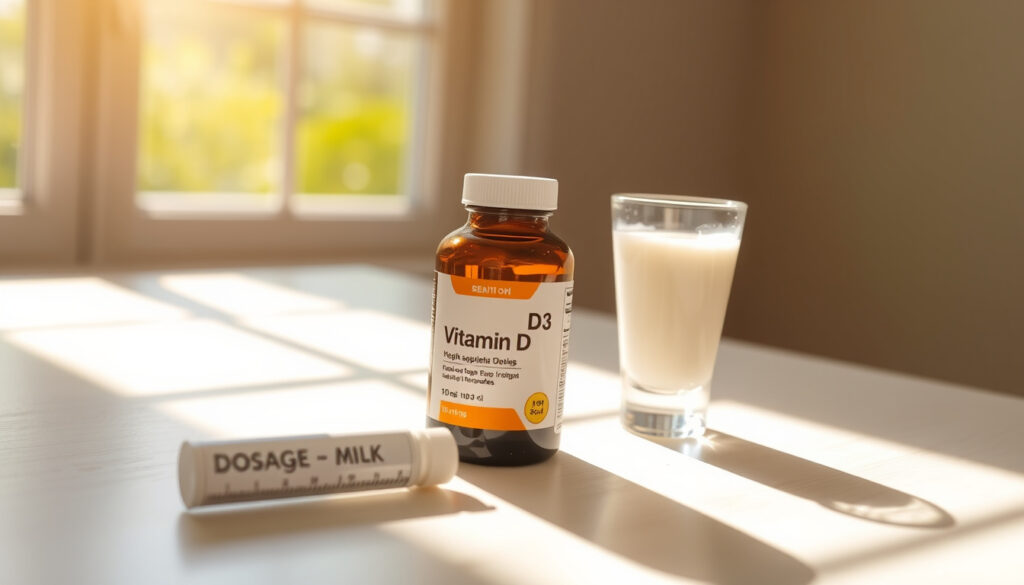
How Much Vitamin D3 Should I Take Daily? Safe Dosage Guide
You’ve probably stood in the supplement aisle wondering if that bottle of vitamin D3 is worth it—and if so, how many of those tiny capsules you actually need. Official guidelines do exist, but popular supplement doses don’t always match, and the advice can feel contradictory. This article compares recommendations from major health authorities so you can find a safe, effective daily target that fits your life.
Recommended daily intake for adults: 600–800 IU (15–20 mcg) ·
Upper tolerable limit (adults): 4,000 IU (100 mcg) ·
Common supplement dose range: 1,000–2,000 IU per day ·
Dose for correcting deficiency: 1,000–5,000 IU daily under medical supervision ·
Percentage of US adults with insufficient levels: ~40% (NIH Office of Dietary Supplements)
Quick snapshot
- RDA for adults 19–70: 600 IU daily (NIH Office of Dietary Supplements)
- Upper tolerable intake for adults: 4,000 IU daily (NHS)
- Vitamin D3 is more effective at raising blood levels than D2 (NIH Office of Dietary Supplements)
- Optimal blood level of 25-hydroxyvitamin D remains debated
- Whether routine supplementation above 2,000 IU provides additional benefits for the general population is not conclusively proven
- The exact dose needed to correct mild insufficiency varies by individual genetics and lifestyle
- Toxicity usually only occurs with doses >10,000 IU daily for months (NIH Office of Dietary Supplements)
- Blood levels peak 2–3 months after starting a consistent dose (NIH Office of Dietary Supplements)
- Check your vitamin D blood level if you have risk factors (low sun exposure, dark skin, osteoporosis)
- Consult a doctor for a personalized dose, especially if considering >2,000 IU daily
- Re-test after 3–6 months of supplementation to confirm target level
Five key figures from the guidelines, one pattern: official recommendations cluster around a narrow safe band, but many people need slightly more to reach optimal blood levels.
| Metric | Value |
|---|---|
| RDA for adults (19–70) | 600 IU (15 mcg) |
| RDA for adults 71+ | 800 IU (20 mcg) |
| Upper tolerable intake level (adults) | 4,000 IU (100 mcg) |
| NHS recommended supplement dose | 400 IU (10 mcg) daily |
| Common OTC supplement dose | 1,000 – 2,000 IU per capsule |
| Deficiency treatment dose | 1,000 – 5,000 IU daily (doctor-supervised) |
| Percentage of US adults with insufficient levels | ~40% (NIH Office of Dietary Supplements) |
| Safe upper limit (NHS, Mayo Clinic, Harvard) | 4,000 IU daily |
| Typical replacement dose for deficiency | ≥2,000 IU daily (Cleveland Clinic Journal of Medicine) |
How much vitamin D3 should I take daily?
Recommended daily intake for adults (19–70 years)
- The U.S. National Institutes of Health Office of Dietary Supplements (U.S. federal health agency) sets the RDA at 600 IU (15 mcg) per day for adults ages 19–70 (NIH ODS Consumer Fact Sheet).
- For those over 70, the RDA increases to 800 IU (20 mcg) per day (same source).
- The NHS (U.K. national health service) states that 400 IU (10 mcg) a day is enough for most people who choose to take a supplement (NHS Vitamin D guidance).
- Mayo Clinic (nonprofit academic medical center) agrees: 600 IU for ages 1–70, 800 IU for over 70 (Mayo Clinic Vitamin D overview).
- Harvard Health Publishing (Harvard Medical School’s consumer health division) echoes the same figures (Harvard Health).
For a generally healthy adult, 600–800 IU daily sits squarely within every major guideline. But that number assumes you get some sun—without it, you may need more to maintain optimal blood levels.
Factors that influence individual vitamin D needs
- Low sun exposure: Northern latitudes, indoor work, or consistent sunscreen use reduce skin synthesis.
- Darker skin: Higher melanin reduces vitamin D production from sunlight by up to 90% (NIH ODS).
- Osteoporosis or bone health conditions: Higher intake may be indicated under medical supervision.
- Gender-specific: Women, especially postmenopausal, may need higher doses to maintain bone density, but official RDAs do not differ between men and women (both 600 IU).
- Age over 70: RDA jumps to 800 IU because skin synthesis declines.
The pattern: guidelines give a floor, not a ceiling. Individual risk factors can shift the target dose upward within the safe zone.
How to determine your own target dose
- Ask your doctor for a 25-hydroxyvitamin D blood test. Levels below 30 ng/mL (75 nmol/L) are generally considered insufficient (Cleveland Clinic Journal of Medicine).
- Choose a daily dose between 1,000 and 2,000 IU if you have risk factors and want to optimise levels—most experts consider this safe and effective for the general adult population (Mayo Clinic).
- If you take vitamin D3 (cholecalciferol) rather than D2 (ergocalciferol), you get a more potent and longer-lasting rise in blood levels (NIH ODS).
Is 1000 IU of vitamin D3 a day too much?
Safety of 1000 IU daily
- 1000 IU is well below the adult upper limit of 4,000 IU (NIH ODS, NHS).
- It is considered safe for most adults and is a standard over-the-counter dose (Harvard Health).
- Healthline (health information resource) notes that 1,000–4,000 IU daily is safe for people who need more vitamin D (Healthline).
Who might need 1000 IU versus a lower dose
- Someone with limited sun exposure or darker skin may benefit from 1,000 IU daily to maintain adequate levels.
- If you already get sun or eat fortified foods, 400–600 IU may suffice.
- GoodRx (health resource) presents the adult RDA table showing 600 IU for ages 19–70 (GoodRx Vitamin D dosage article).
Comparison with official upper limits
Four common doses, one quick comparison: how each stacks up against the safety ceiling.
| Dose (IU) | NIH ODS | NHS | Mayo Clinic | Harvard Health |
|---|---|---|---|---|
| 400 | RDA for children 1–3 | Recommended supplement dose | RDA for infants | Not specifically mentioned |
| 600 | RDA for adults 19–70 | Higher than NHS advice | RDA for adults 1–70 | RDA for ages 1–70 |
| 800 | RDA for adults 71+ | Higher than NHS advice | RDA for adults 71+ | RDA for ages 71+ |
| 1,000 | Above RDA but safe | Safe (UL 4,000) | Safe, common supplement dose | Safe upper limit 4,000 |
| 2,000 | Above RDA but safe | Safe (UL 4,000) | Safe, common supplement dose | Safe upper limit 4,000 |
| 4,000 | UL for adults | Do not exceed | May cause adverse effects | Do not exceed without medical advice |
| 5,000 | Exceeds UL | Exceeds UL | Exceeds recommended limit | Exceeds safe upper limit |
The trade-off: 1,000 IU is a safe, middle-ground dose that many adults can take without worry. But if your only goal is to meet the RDA, 600 IU is sufficient.
What is the maximum vitamin D3 you can take daily?
Tolerable upper intake level (UL) by age group
- Adults 19 and older: 4,000 IU (100 mcg) per day (NIH ODS, NHS).
- Children 1–3 years: 1,000 IU; 4–8 years: 1,500 IU; 9–13 years: 2,000 IU (NIH ODS).
- Pregnant and breastfeeding women: 4,000 IU daily (NIH ODS).
Risks of exceeding the maximum
- Long-term intake above 4,000 IU can cause hypercalcemia (elevated blood calcium) and kidney damage (NHS).
- Early signs: nausea, vomiting, constipation, weakness.
- Advanced symptoms include confusion, kidney stones, and irregular heartbeat (NIH ODS).
When a doctor may prescribe higher doses
- For diagnosed deficiency, short-term doses up to 5,000 IU or higher are sometimes used under medical supervision (Cleveland Clinic Journal of Medicine).
- Patients with malabsorption disorders (e.g., Crohn’s, celiac) may need higher doses.
- Once levels normalise, the dose is reduced to a maintenance level.
The UL is not a target—it’s a ceiling. Staying below 4,000 IU daily avoids known toxicity, but more is not automatically better. The goal is adequate, not maximal, blood levels.
The implication: staying under 4,000 IU keeps you safe, but the right dose for you depends on your individual blood levels and risk factors.
Is it okay to take 5000 IU of vitamin D3 every day?
Is 5000 IU safe for long-term use?
- 5000 IU exceeds the UL of 4,000 IU and is not recommended without medical oversight (NIH ODS, Mayo Clinic).
- WebMD (health information site) notes that older adults can take an average of 4,000 IU a day safely, but does not endorse 5,000 IU (WebMD Vitamin D dosage for older adults).
- Consistently taking 5,000 IU increases the risk of toxicity over time.
Situations where 5000 IU might be prescribed
- Short-term correction of severe deficiency (e.g., blood levels <12 ng/mL) (Cleveland Clinic Journal of Medicine).
- Some clinical studies use 5,000 IU daily for a limited period (e.g., 8–12 weeks).
- After correction, the dose is lowered to a maintenance level (usually 1,000–2,000 IU).
Signs you should lower your dose
- Nausea, vomiting, metallic taste, muscle weakness.
- Blood calcium levels rising above the normal range.
- Kidney pain or blood in urine (possible kidney stones).
The pattern: 5,000 IU is a therapeutic dose, not a daily supplement. Unless guided by a doctor, stick with the established safe range.
If you’re tempted by high-dose D3 capsules on the shelf, check the label: many single capsules contain 5,000 IU. That’s a deliberate dose for deficiency treatment, not everyday wellness. Use it only on medical advice.
The takeaway: for general health, 5,000 IU daily without medical supervision crosses into unnecessary risk—stick with lower doses unless a doctor directs otherwise.
What are 5 physical signs you’re taking too much vitamin D?
Early symptoms of vitamin D toxicity
- Nausea
- Vomiting
- Constipation
- Muscle weakness
- Loss of appetite
These signs appear because vitamin D toxicity raises blood calcium levels (NIH ODS).
How hypercalcemia manifests
- As calcium builds up, confusion, kidney stones, and irregular heartbeat can develop (NIH ODS).
- Advanced hypercalcemia may require hospitalisation to lower calcium levels.
- Toxicity usually only occurs with doses >10,000 IU daily for several months (NIH ODS).
What to do if you suspect excess intake
- Stop the supplement immediately and contact your healthcare provider.
- A blood test for calcium and 25-hydroxyvitamin D can confirm toxicity.
- Treatment includes discontinuing vitamin D, dietary calcium restriction, and sometimes medical management.
Why this matters: the 5,000 IU supplements popular online are real benefit for some, but a real risk for others—know the warning signs before you start a high dose.
Confirmed facts
- The RDA for vitamin D is 600 IU for adults aged 19–70 (NIH, NHS, Mayo Clinic).
- Long-term intake above 4,000 IU daily can cause toxicity (NHS, Harvard Health).
- Vitamin D3 is more effective at raising blood levels than D2 (NIH ODS).
What’s unclear
- Optimal blood level of 25-hydroxyvitamin D remains debated.
- Whether routine supplementation above 2,000 IU provides additional benefits for the general population is not conclusively proven.
- The exact dose needed to correct mild insufficiency varies by individual genetics and lifestyle.
“For most people, 600 IU is enough, but if you have limited sun exposure, you may need more.”
— Dr. Joanne Slavin, University of Minnesota (nutrition researcher)
“If you’re taking a vitamin D supplement, you probably don’t need more than 600 to 800 IU per day.”
— Harvard Health Publishing (Harvard Medical School’s consumer health division)
“Do not take more than 100 micrograms (4,000 IU) of vitamin D a day as it could be harmful.”
— NHS (U.K. national health service)
For a generally healthy adult living in the U.S. or U.K. with moderate sun exposure, the safest and most evidence-based choice is to stick with 600–800 IU daily, or 1,000–2,000 IU if you have risk factors—and never cross 4,000 IU without a doctor. The difference between meeting the RDA and optimising your blood level is small but meaningful, and a simple blood test can settle it. For the average adult, the choice is clear: stay within the safe band, get your levels checked, and let the data guide you.
Frequently asked questions
What is the difference between vitamin D2 and D3?
Vitamin D2 (ergocalciferol) comes from plant sources, while D3 (cholecalciferol) is produced in skin and found in animal foods. D3 is more effective at raising and maintaining blood levels (NIH ODS).
Can I get enough vitamin D from sunlight alone?
Yes, if you have regular, moderate sun exposure on bare skin (10–30 minutes mid-day, several times a week). However, season, latitude, skin tone, and sunscreen use affect synthesis. Many people need supplementation to maintain adequate levels (NIH ODS).
Is it safe to take vitamin D with other medications?
Vitamin D interacts with some medications, including steroids, weight-loss drugs (orlistat), and some cholesterol-lowering medications. Always consult your doctor if you take prescription medications (NIH ODS).
How long does it take to correct a vitamin D deficiency?
With a consistent supplement dose of 1,000–5,000 IU daily (under medical supervision), blood levels typically normalise in 2–3 months (Cleveland Clinic Journal of Medicine).
What foods are high in vitamin D?
Fatty fish (salmon, mackerel, sardines), cod liver oil, egg yolks, and fortified foods (milk, orange juice, cereals) are good sources (NIH ODS).
Should I take vitamin D with food?
Yes—vitamin D is fat-soluble, so taking it with a meal containing fat increases absorption (NIH ODS).
Does vitamin D3 interact with calcium?
Vitamin D helps the body absorb calcium. Taking them together supports bone health, but excessive amounts can lead to hypercalcemia. The safe limits for vitamin D (4,000 IU) and calcium (2,500 mg for adults) should not be exceeded (NIH ODS Calcium).
Can children take the same dose as adults?
No. Children have lower RDAs and ULs: infants 400 IU, ages 1–13 600 IU, UL ranges from 1,000 to 3,000 IU depending on age (NIH ODS).
More related posts
 David Lynch Movies and TV Shows – Filmography, Rankings, Watch Order
 Olivia Attwood: Split, ADHD, and Life After Love Island
 Notes on a Scandal: Plot, Cast, Reviews & Where to Watch
 Leicester City vs Brentford – Score, Stats, Lineups and Analysis
 Days Out with Kids – Manchester Family Attractions and Deals
 Man U vs Liverpool – 2026 Fixture Date Tickets History
 TalkTalk Live Chat: How to Access and Contact Support
 What Is a Pronoun – Definition, Types and Examples
