St Bartholomew the Great – History Map Services Photos
St Bartholomew the Great stands as London’s oldest surviving parish church and priory, maintaining continuous worship since its foundation in 1123. Nestled in the Smithfield district near the Barbican, this Augustinian foundation has withstood the Dissolution of the Monasteries, the Great Fire of London, and centuries of urban transformation to remain an active place of worship nine centuries later.
Founded by Rahere, a former court jester who became a prebendary of St Paul’s Cathedral, the priory emerged from a vision experienced during illness at the Vatican. King Henry I granted the Smithfield land for the construction, which began as both a religious house and St Bartholomew’s Hospital, creating an enduring spiritual and medical legacy that continues to define the area today.
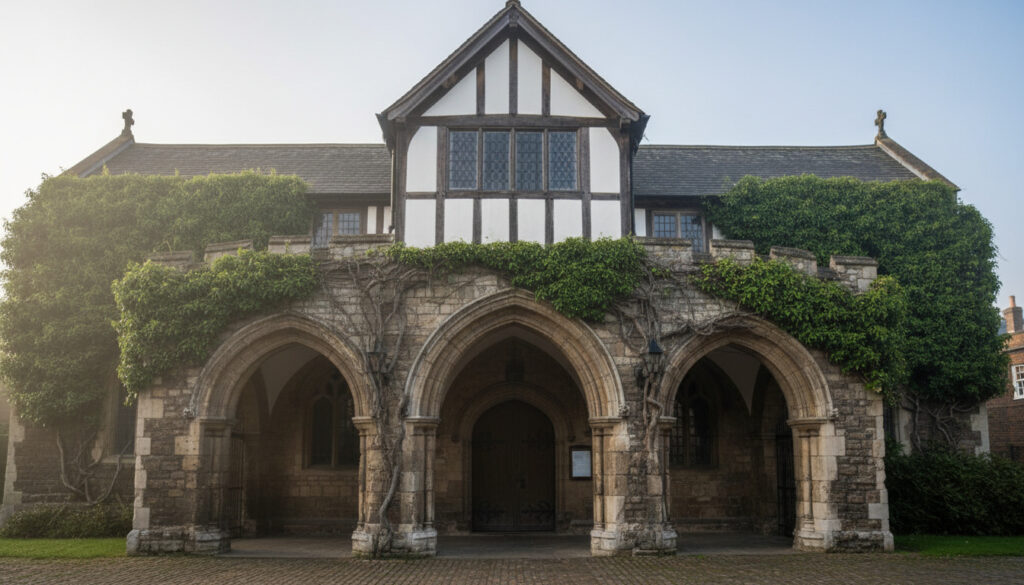
The church’s survival through the demolition of its nave during the Reformation, its role as a printing workshop where Benjamin Franklin once worked, and its recent 900th anniversary celebrations with contemporary art installations demonstrate its remarkable ability to adapt while preserving its medieval core. Visitors enter through a Tudor gatehouse erected around 1595, passing over a 13th-century archway that marks the boundary between the modern City and England’s distant religious past.
What is the history of St Bartholomew the Great?
- Medieval priory that survived the Dissolution with its choir intact
- Professional choral tradition spanning nine centuries
- Notable film location and architectural heritage site
- Augustinian origins tied to St Bartholomew’s Hospital
- Escaped the 1666 Great Fire due to firebreak walls
- Repurchased its former Lady Chapel in 1885 after secular use
- Celebrated its 900th anniversary in 2023
| Attribute | Detail |
|---|---|
| Location | Smithfield, London EC1 |
| Founded | 1123 by Rahere |
| Consecrated | 1133 |
| Status | Priory Church |
| Denomination | Church of England |
| Architectural Feature | Tudor gatehouse (c.1595) |
| Survived | Great Fire of London 1666 |
| Anniversary | 900th in 2023 |
The Augustinian Foundation
Rahere established the priory after a vision of St Bartholomew while ill in Rome, as documented in historical records. King Henry I granted the Smithfield site, previously a cemetery, for the construction of both the church and hospital. The foundation stone was laid in 1123, with the church consecrated a decade later in 1133. Henry I issued a royal charter protecting the foundation and granted rights to hold England’s premier cloth fair, establishing the site’s economic significance alongside its spiritual role.
Prior Thomas, serving from 1144 to 1174, expanded the community from 13 to 35 canons, necessitating physical expansion of the church. He secured papal privileges from Anastasius IV, Adrian IV, and Alexander III, attracting wealthy patrons who funded chantry bequests. Miracles, including healings and a heavenly light manifestation on St Bartholomew’s Day (August 24), drew pilgrims to both the priory and the hospital, as detailed in archival research.
Survival Through the Centuries
The Dissolution of the Monasteries in 1539 brought closure under Henry VIII. Sir Richard Rich oversaw the demolition of the nave in 1543, selling the materials, but the choir survived as the parish church, endowed with seven properties to support the rector. This selective preservation left the church with its current truncated form, entered through what was originally the crossing. Further details appear in contemporary historical analysis.
The priory walls served as a firebreak during the Great Fire of London in 1666, sparing the structure while much of the surrounding City burned. The church subsequently fell into disrepair until Canon Edwin Savage’s tenure, when restoration works exceeded £60,000. The former Lady Chapel, which had served as a printing workshop where Benjamin Franklin worked in 1724, was repurchased in 1885 and reintegrated into the church complex.
Where is St Bartholomew the Great and how do I get there?
St Bartholomew the Great map
The church occupies a position in Smithfield, central London, adjacent to St Bartholomew’s Hospital and near the Barbican Centre. The main entrance sits at Cloth Fair, accessed through a distinctive Tudor gatehouse built around 1595 over a surviving 13th-century archway, as described in London historical guides. This entrance marks the former southern boundary of the nave, which once extended further south before its demolition during the Reformation. The site overlaps historically with the former parishes of St Botolph Aldersgate and St Sepulchre, reflecting the complex parochial geography of medieval London.
St Bartholomew the Great photos
Visual documentation of the site reveals several key features. The Tudor gatehouse and underlying 13th-century archway provide the primary photographic subject, marking the transition from the modern street to the medieval precinct. Inside, the surviving choir exhibits medieval stonework and architectural details spanning multiple centuries. The churchyard occupies the site of the former nave, creating an open space that hints at the original scale of the Augustinian priory. 4K video footage showcases the interior’s medieval features, highlighting its status as London’s oldest continuous worship site.
The main entrance via the Tudor gatehouse at Cloth Fair leads visitors through the surviving 13th-century archway into the churchyard, which stands on the site of the former nave demolished in 1543.
What services and music are offered at St Bartholomew the Great?
St Bartholomew the Great Evensong
Evensong services occur regularly at the church, maintaining a choral tradition that connects directly to its nine centuries of worship. Photographic records show Archbishop Stephen Cottrell attending “Evensong in the City” at the church, indicating its continued role in London’s religious life. These services take place within the medieval choir, offering worshippers the experience of Anglican liturgy in a space designed for monastic prayer. The church maintains a full list of priors and priests on its official site, documenting the continuous clerical presence since 1123.
St Bartholomew the Great music list
While specific current music lists are not publicly detailed in available sources, the church hosts choral evensong consistent with its historic setting. The musical tradition ties directly to the 900 years of worship celebrated in 2023. Visitors interested in particular service music or upcoming choral performances should consult the official church website for the most current schedules and repertoire information.
What is the connection to St Bartholomew the Less and St Bartholomew Hospital?
St Bartholomew the Less
St Bartholomew the Less operates as a separate, smaller church situated within St Bartholomew’s Hospital in Smithfield. Though associated with the same historic hospital foundation established by Rahere in 1123, it does not form part of the priory church itself. This distinction matters for visitors seeking the specific ancient architecture of the priory church, as the two sites, while geographically proximate and historically linked, maintain separate identities and functions within the modern hospital precinct.
St Bartholomew Hospital
St Bartholomew’s Hospital represents the medical twin of the religious foundation, established simultaneously by Rahere in 1123. The hospital has operated on the Smithfield site for nine centuries, making it one of the oldest medical institutions in Europe. The close physical proximity of the hospital to the priory church reflects the Augustinian tradition of combining spiritual care with physical healing. This relationship continues today, with the church serving the spiritual needs of hospital patients, staff, and the surrounding medical community.
St Bartholomew the Great served as the priory church for the Augustinian canons, while St Bartholomew the Less functioned as the hospital’s chapel, reflecting the dual spiritual and medical mission of the 1123 foundation.
The Dissolution of 1539 resulted in the demolition of the priory nave in 1543; only the choir survived to serve as the parish church, explaining the current asymmetrical layout visible today.
How has St Bartholomew the Great changed over nine centuries?
- 1123: Rahere lays the foundation stone following his vision; construction of the priory and hospital begins. Source: The Past
- 1133: Consecration of the church; Henry I grants royal charter and cloth fair rights. Source: The Past
- Before 1180: Construction of the larger Lady Chapel following Canon Hubert’s vision. Source: St Bartholomew the Great Official
- 1531: Bishop of London recognizes separate parochial status amid tithe disputes. Source: The Past
- 1539: Dissolution of the Monasteries closes the priory. Source: Wikipedia
- 1543: Nave demolished; choir survives as parish church. Source: Living London History
- 1666: Great Fire of London; church survives due to firebreak walls. Source: St Bartholomew the Great Official
- 1724: Benjamin Franklin works in the Lady Chapel printing workshop. Source: St Bartholomew the Great Official
- 1885: Church repurchases the former Lady Chapel. Source: St Bartholomew the Great Official
- 2023: 900th anniversary celebrations include installation of Damien Hirst’s “Exquisite Pain” statue. Source: St Bartholomew the Great Official
What is established and what remains uncertain about St Bartholomew the Great?
| Established Facts | Uncertain or Variable Information |
|---|---|
|
|
What is the significance of St Bartholomew the Great in London’s religious landscape?
St Bartholomew the Great occupies a unique position as the physical link to London’s Augustinian past, bridging the medieval monastic tradition with modern urban worship. Its location in Smithfield, historically a site of both commerce and execution, provided a spiritual counterpoint to the area’s secular activities, particularly through the cloth fair granted by Henry I. The church’s survival of the Reformation’s destructive phase, when the nave was stripped for materials but the choir preserved for parish use, created an architectural palimpsest that reveals the changing religious priorities of Tudor England.
The connection to Books of the Bible – Complete List in Order reflects the deep scriptural traditions maintained within its walls, while the proximity to St Bartholomew’s Hospital continues the founder’s original vision of pairing spiritual and physical care. Unlike many contemporary foundations that disappeared entirely during the Dissolution, this priory church maintained its essential function, adapting from monastic choir to Anglican parish church without losing its architectural integrity or community role.
What sources document the history of St Bartholomew the Great?
“Rahere, a court jester and prebendary of St Paul’s Cathedral, founded the priory church and St Bartholomew’s Hospital after a vision from St Bartholomew during illness at the Vatican; King Henry I granted the Smithfield land, previously a cemetery, for construction using local stones gathered by servants and child laborers.”
— Historical archives
“The church escaped the 1666 Great Fire of London due to its priory walls acting as a firebreak.”
— Parish records
What should visitors remember about St Bartholomew the Great?
St Bartholomew the Great offers a rare opportunity to experience continuous medieval worship in London’s oldest surviving parish church, where nine centuries of history remain tangible in the stone and silence of the surviving choir. Whether attending Evensong, exploring the Tudor gatehouse, or contemplating the Damien Hirst statue commemorating the 900th anniversary, visitors encounter a site that has balanced preservation with adaptation since 1123. Those interested in related historical contexts might also consult Blood Clot in Leg Symptoms – Key Signs to Watch for health awareness when visiting historic sites requiring extended walking or standing.
Frequently asked questions
Who was Rahere, the founder of St Bartholomew the Great?
Rahere was a court jester who became a prebendary of St Paul’s Cathedral. He founded the priory in 1123 after a vision of St Bartholomew during illness in Rome.
Is St Bartholomew the Great the oldest church in London?
It is London’s oldest surviving parish church and priory with continuous worship since 1123, though not the oldest Christian foundation in the city.
What happened to the original nave of the church?
The nave was demolished in 1543 during the Dissolution of the Monasteries under Henry VIII, with materials sold by Sir Richard Rich. Only the choir survived as the parish church.
Can visitors attend services at St Bartholomew the Great?
Yes, the church maintains regular worship including Evensong services. Visitors should check current schedules as specific times may vary.
What is the Damien Hirst statue “Exquisite Pain”?
Installed for the 900th anniversary in 2023, this statue depicts St Bartholomew’s flaying and stands within the church as contemporary art marking the historic milestone.
How is St Bartholomew the Less different from the Great?
The Less is a smaller church within St Bartholomew’s Hospital, while the Great is the former priory church. They share the 1123 foundation but remain separate buildings.
More related posts
 OVO Energy Top Up – Online, App and In-Store Guide
 A Seal Pushed Me Yesterday in French – Viral Meme Explained
 Ed Sheeran Portman Road 2025: Dates, Tickets & Guide
 Giannis Antetokounmpo Trade Rumors and Injury Controversy
 Sol de Janeiro Gift Set – 2024 Prices and Contents Guide
 Adin Ross Net Worth, Crypto Losses, and Tate Link
 Hooligan Hefs: Biography, Tour, Songs & Real Name
 Cast of Mix Tape – Actors, Characters and BBC Details
