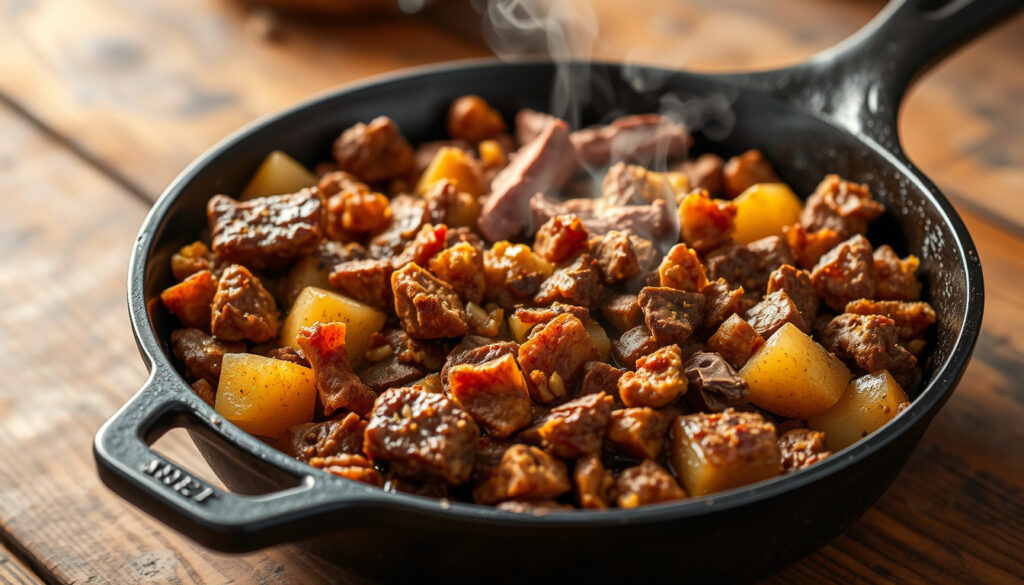
Corned Beef Hash Recipe: Perfect Crispy Crust Guide
There’s something deeply satisfying about cracking open a tin of corned beef and knowing exactly what to do with it. This humble storecupboard staple — beef, potatoes, onions — has fed British families for generations, and once you learn the trick to getting that golden, crispy crust, you’ll understand why the recipe refuses to disappear from dinner tables across the UK.
Primary Protein: Corned beef · Key Vegetable: Potatoes · Common Add-ins: Onions, peppers · Serving Style: Breakfast or dinner
Quick snapshot
- Pan-fried method is standard practice (Foodle Club)
- 340g tinned corned beef and 680g potatoes form the base ratio (Foodle Club)
- Refrigerates for up to 4 days when stored properly (Foodle Club)
- Exact gluten content varies by brand — some report gluten-free status, others don’t confirm (Foodle Club)
- Nutritional data per serving lacks consistent measurement across recipes (Foodle Club)
- Regional variants remain popular — Northern England and Scottish versions still appear in family kitchens (Foodle Club)
- Online recipes have proliferated since the 2010s, bringing new attention to this retro comfort dish (Foodle Club)
| Label | Value |
|---|---|
| Core Ingredients | Corned beef, potatoes, onions |
| Typical Cuisine | British storecupboard |
| Gluten Status | Brand-dependent, e.g. Hormel checked |
| Prep Time | 10 minutes |
| Cook Time | 35 minutes |
| Total Time | 45 minutes |
| Servings | 4 |
How to make a good corned beef hash?
The basic formula is straightforward: canned corned beef, potatoes, and onions. What separates a good hash from a mediocre one comes down to technique — specifically, how you handle the potato and whether you give the mixture enough time to form a proper crust.
Ingredients needed
For a traditional UK-style corned beef hash, you’ll want 340g of tinned corned beef, 680g of potatoes, and 1 large onion as your foundation (Foodle Club). That’s roughly a 1:2 ratio of beef to potato, which gives you enough starchy base to hold the dish together while keeping the flavour of the corned beef front and centre.
From there, flavour additions vary by region and household. The most common UK additions are Worcestershire sauce and a spoonful of tomato puree — these two ingredients add depth and a faint tang that elevates the dish beyond basic (Foodle Club). In Northern England specifically, Henderson’s relish is the traditional swap for Worcestershire sauce (Foodle Club).
For the potato choice, russet potatoes work well — dice them to roughly 4 cups of chopped pieces (The Country Cook). The key is selecting potatoes that will hold their shape during frying rather than crumbling into mush.
The beef-to-potato ratio matters more than exotic ingredients. Stick to 340g beef / 680g potato as your base, then build flavour with what you have in the cupboard.
Step-by-step cooking method
- Prep the potatoes: Peel and dice your potatoes into roughly 2cm cubes. Parboil them for 3 minutes — this is the secret to achieving crispiness without ending up with raw centres (Foodle Club). Alternatively, boil diced potatoes for 5-10 minutes until fork tender, then drain thoroughly before frying (The Country Cook).
- Soften the aromatics: Fry an onion for 3-5 minutes until soft and starting to brown (Don’t Go Bacon My Heart). Add garlic after the onion and cook for roughly 1 minute (Honest And Truly).
- Brown the beef: Cut corned beef into 1-inch blocks before frying (Foodle Club). Fry on high heat for 2-3 minutes until you see crispy bits forming on the bottom of the pan (Foodle Club). Resist the urge to stir constantly.
- Add potatoes and form the crust: Add your parboiled potatoes to the pan. Press the hash down firmly with a spatula and cook undisturbed for 3-5 minutes per side — this is how you build that golden crust (The Country Cook). Flip and repeat the pressing process, aiming for 3 complete cycles (The Country Cook).
- Finish and season: Add Worcestershire sauce (or Henderson’s relish) and tomato puree if using. Cook for a total of about 20 minutes, flipping every 5-7 minutes for even browning (Honest And Truly).
Serving suggestions
In the UK, a fried egg on top is the classic finishing touch — the runny yolk becomes part of the dish when you cut in (Stow Cafe). Baked beans on the side is another popular pairing, particularly for breakfast-style servings (Nicky’s Kitchen Sanctuary).
The dish works equally well as a weeknight dinner or a hearty breakfast. Many families report it as a favourite “storecupboard supper” when fresh ingredients are running low.
The total cook time is roughly 45 minutes (10 minutes prep, 35 minutes cooking) for 4 servings — that’s faster than most takeaway options and far more satisfying (Don’t Go Bacon My Heart).
What makes corned beef hash so good?
Corned beef hash sits in that rare category of dishes that’s greater than the sum of its parts. Three humble ingredients combine to create something with real comfort-food appeal.
Flavor combinations
The flavour profile works because of contrast. The potatoes soak up the salty, slightly sweet brine notes from the corned beef during cooking. The onion adds sweetness and foundation. And the Worcestershire or tomato puree brings acid and umami that ties everything together.
This isn’t a dish that relies on subtle complexity — it’s about big, honest flavours that hit the spot after a long day. As the Foodle Club author puts it: “This easy British corned beef hash recipe takes me right back to my childhood. This is traditional northern England food at its finest.”
“Old Fashioned Corned Beef Hash is a delightfully easy and delicious UK retro dish that is still an economical way to feed your family.”
— Apply to Face Blog (Recipe Blogger)
Texture secrets
The appeal of corned beef hash is inseparable from its texture — specifically, the contrast between the crispy exterior and soft interior. Getting that crust is the technical challenge that makes or breaks the dish.
The key principles: don’t overcrowd the pan, don’t stir too frequently, and press the mixture down firmly with a spatula. As Chef Savvy notes, the goal is to “smush potatoes and corned beef into even layer, cook undisturbed 2-3 minutes per side.”
If you’re seeing steam instead of sizzling, that’s a sign the pan is too crowded and the moisture isn’t evaporating properly. The Maillard reaction — that browning that creates flavour and texture — needs dry heat.
What’s the secret to good corned beef hash?
Every home cook who’s mastered this dish will tell you the same thing: patience with the pan and restraint with the spatula. But there are a few more specific techniques worth knowing.
Ingredient prep tips
The parboil isn’t optional — it’s structural. Potatoes cut into cubes have a lot of surface area, and if you try to fry them raw, the outside will burn before the inside cooks through. A 3-minute parboil (Foodle Club) or 5-10 minute boil until fork tender (The Country Cook) gets the potatoes to the right stage of tenderness without making them fall apart.
Drain potatoes thoroughly before they hit the pan. Any excess moisture dilutes the browning process and leads to that frustrating sizzle-then-steam scenario.
Cooking techniques
The cooking sequence matters. Some recipes call for shallow frying the potatoes first until crispy, then discarding excess oil before adding other ingredients (Don’t Go Bacon My Heart). Others prefer to cook the onion first, then add beef, then potatoes. Either approach works if you follow the core principle: get the surface moisture out, then build the crust.
The pressing technique deserves emphasis. Don’t just mix everything and leave it. After each flip, press down firmly for 10-15 seconds. This compresses the layers and creates more surface contact with the pan — more contact means more browning.
The total hash cooking time is roughly 20 minutes, with flips every 5-7 minutes for even browning (Honest And Truly). That’s long enough to develop colour without burning.
“Looking for a hearty, no-fuss, traditional British meal? This Northern-style corned beef hash is a comfort food classic.”
— Proper Northern Corned Beef Hash (Video Host)
The implication: the techniques are simple, but they require you to resist fidgeting with the pan. Set a timer, press when it beeps, flip when it signals.
How to keep corned beef hash from falling apart?
The most common complaint about homemade corned beef hash is that it won’t hold together. It falls apart when you try to flip it, crumbles on the plate, or turns into a mushy mess. Here’s why that happens and how to prevent it.
Potato handling
The potato is the binding agent. If your potatoes are overcooked before they hit the pan, they’ll be too soft to hold structure during frying. This is why the parboil timing matters — you’re not cooking the potato, you’re just softening the exterior enough to allow frying.
Equally important: let the potatoes dry after parboiling. Spread them on a clean tea towel or kitchen paper for a minute or two. Surface moisture is the enemy of browning.
The variety also plays a role. Waxy potatoes hold their shape better than floury ones. If you’re using a floury variety (like Maris Piper), be more conservative with the parboil time.
Binding methods
Beyond potato handling, the way you layer and cook the hash affects how well it holds. The key is creating layers that fuse together as they cook. This happens through pressure and sustained heat — not through adding binders like eggs or flour.
Avoid stirring too much once everything is in the pan. Each time you stir, you’re breaking the forming crust and preventing the layers from welding together (Don’t Go Bacon My Heart). Resist the instinct to move things around — let the spatula do the work during the flip.
If you’re still having trouble holding together, a longer initial sear can help. The longer the first side cooks (without disturbance), the more structural integrity the bottom develops before you flip.
More pressing means more crust — but also more chance of burning. If you press too hard on high heat, the bottom can scorch before the centre cooks through. Medium-high heat and patient pressing is the safer path.
What are common mistakes when making corned beef hash?
Beyond the structural issues of holding together, there are several specific mistakes that home cooks report making. Learning from them will save you frustration.
Prep errors
The most frequent prep mistake is trying to rush the potato cooking. Raw potato centres are a textural disaster — hard and crunchy when they should be soft. This is entirely preventable with proper parboiling (Foodle Club).
Another common error: not cutting the corned beef into proper-sized chunks. If you just scoop it from the tin in uneven globs, it won’t distribute evenly through the hash. Cutting into 1-inch blocks (Foodle Club) before frying ensures each piece gets contact with the hot pan.
Underestimating the onion quantity is less catastrophic but still affects the result. One large onion is the minimum — doubling it will make the hash more flavourful and help with browning.
Cooking pitfalls
The biggest cooking pitfall is insufficient heat. Hash needs to sizzle, not simmer. If you hear a soft sizzle-then-fizzle, the heat is too low. You want an active, aggressive sizzle that continues as the moisture evaporates.
Overcrowding the pan is the other major issue. If the pan looks full, it’s too full. Overcrowding drops the pan temperature drastically and turns the cook into a steaming exercise. Cook in batches if needed.
The final pitfall: flipping before the crust has formed. You should see visible browning and hear the sizzle change in character before you attempt to flip. Forcing it before the crust sets results in collapse.
“Here I’ll show you how to make corned beef hash with canned corned beef. It’s crispy, flavoursome and super easy to make!”
— Don’t Go Bacon My Heart (Recipe Developer)
Upsides
- Uses affordable, shelf-stable ingredients that keep for months
- Fast to make — 45 minutes total from start to plate
- Flexible with add-ins based on what you have available
- Stores well for up to 4 days refrigerated (Foodle Club)
- Reheats successfully — excellent for batch cooking
Downsides
- Achieving crispiness requires patience and practice
- High sodium content from corned beef — not suitable for low-sodium diets without modification
- Gluten status unclear — brand-dependent, requires checking labels
- Can fall apart easily if potato or cooking technique is off
The pattern: the dish rewards attention but doesn’t tolerate neglect. For cooks willing to stay present at the stove for 20 minutes, the payoff is significant.
Related reading: British Corned Beef Hash · Corned Beef Hash
Mastering corned beef hash often draws from a crispy British corned beef hash that highlights simple steps for golden results without special tools.
Frequently asked questions
Is corned beef hash gluten-free?
It depends on the brand of corned beef. Some brands report gluten-free status while others don’t confirm. The Foodle Club notes that gluten status is “brand-dependent” — always check the label if this is a concern.
Can I use fresh corned beef for hash?
Yes, you can use leftover fresh corned beef — this is actually closer to the American tradition, where hash originated from boiled dinner leftovers. However, most UK recipes specifically call for tinned corned beef because it’s already cooked and seasoned. If using fresh, adjust salt levels accordingly.
How long to cook corned beef hash?
The total hash cooking time is approximately 20 minutes after all ingredients are in the pan, flipping every 5-7 minutes for even browning (Honest And Truly). Add 10 minutes prep time and parboiling if counting from scratch.
What to serve with corned beef hash?
The classic UK serving is a fried egg on top, with baked beans on the side (Nicky’s Kitchen Sanctuary). Some prefer it with toast or crusty bread to soak up any excess juices.
Can corned beef hash be frozen?
Most sources focus on refrigeration storage (up to 4 days) rather than freezing. The texture of potatoes can degrade significantly when frozen and reheated, making this a less ideal candidate for long-term storage compared to dishes with more freeze-stable components.
Is Hormel corned beef suitable for celiacs?
Hormel specifically markets some corned beef products as gluten-free, but formulations change. Always verify against the current label if you have coeliac disease — don’t rely on historical information or brand generalisations.
Differences between UK and US corned beef hash?
The UK version uses tinned corned beef primarily and focuses on pan-frying for crispiness. The American version originated from New England boiled dinner leftovers and traditionally included cabbage (Wikipedia). The Midwest US variant uses white sauce to bind the hash, which is different again.
For anyone watching their grocery budget, corned beef hash remains one of the most economical meals in the British storecupboard repertoire — and once you’ve nailed the crispiness technique, you’ll understand why it has outlasted countless food trends.
More related posts
 What Is a GPU – Complete Beginner’s Guide
 Taylor Swift and Travis Kelce: Timeline, Age Difference & Facts
 Wayne Rooney Net Worth 2026: £170M Fortune Revealed
 Cast of Juror No. 2 – Full List, Roles and Key Facts
 Ben & Jerry’s Cookie Dough – Nutrition, Ingredients and UK Guide
 West Indies Cricket Team vs Bangladesh National Cricket Team Match Scorecard – 1st ODI 2025 Result
 Perchance AI: Free Chat, Image Generator & Character Creator Guide
 Call Amazon Customer Service – Official Number and Best Times
