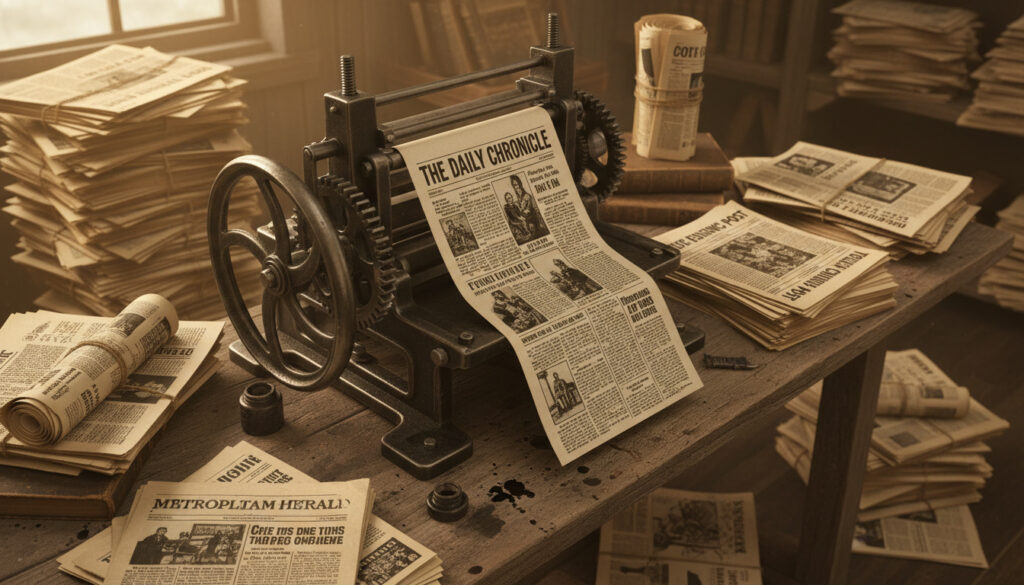
Newspaper – Definition, History, Types and Formats
A newspaper is a periodical publication, typically issued daily or weekly, delivering news, opinions, features, and advertisements on current events of public interest. This definition, drawn from Britannica, highlights its role as a staple information source.
Newspapers have shifted from elite manuscripts to mass media, powered by printing innovations and advertising revenue.
Today, they face digital challenges yet endure in print and online forms.
What is a newspaper?
| Aspect | Key Features |
|---|---|
| Schedule | Typically daily or weekly |
| Content | News, opinions, features, advertisements |
| Revenue | Primarily from display ads, inserts, classifieds |
| Evolution | From ancient bulletins to e-newspapers |
- Newspapers originated with Rome’s Acta Diurna in 59 BC.
- The first printed edition appeared in Germany in 1605.
- Gutenberg’s press in the mid-1400s enabled mass production.
- Formats range from broadsheet to tabloid.
- Geographic variants include national and ethnic papers.
- Advertising drove expansion to wider audiences.
- Digital formats now include e-newspapers and commuter editions.
| Type | Description | Examples |
|---|---|---|
| Broadsheet | Large pages with serious, in-depth news | Financial Times, Daily Mail, The New York Times, The Wall Street Journal |
| Tabloid | Smaller size focusing on sensational stories | New York Post, The Sun (UK) |
| Berliner | Mid-size, 12.4 x 18.5 inches | None specified |
| National dailies | Country-wide coverage | Financial Times |
| Metropolitan dailies | Local or regional focus | Metro Daily |
| Suburban/small town | Community-oriented | Daily Herald |
| Ethnic/language-specific | Tailored to communities | Le Droit |
What types of newspapers exist?
Physical formats
Broadsheets use large pages for detailed reporting aimed at professionals. Tabloids opt for compact sizes with emphasis on celebrities and sports. Berliner offers a middle ground in dimensions.
Broadsheets prioritise depth; tabloids favour brevity and visuals, per Study.com.
Geographic and audience focus
National papers cover broad issues. Metropolitan editions serve cities, while suburban ones target local news. Ethnic publications cater to specific languages or groups.
Frequency and digital shifts
Issues appear daily, weekly, semi-weekly, bi-weekly, or monthly. Modern versions encompass print, microfilm, e-editions, and short commuter reads.
Radio, TV from the 1920s-1950s, and the internet present persistent competition. Check Types of Newspapers for more.
Ads form the core income via display, inserts, and classifieds, transforming papers from elite to mass reach.
How did newspapers originate?
Ancient beginnings
Rome’s Acta Diurna from 59 BC displayed public records on metal or stone in forums, covering politics and events.
Manuscript era
Middle Ages saw trader newsletters, such as those by the Fugger family.
Printed expansion
Johann Carolus launched the first printed paper in 1605. Gutenberg’s mid-1400s press slashed costs, spreading access globally by the 19th century. See Quintype blog.
England saw corantos in 1621, followed by dailies. Explore the History of Newspapers.
Internet and broadcast media continue to challenge traditional models, though papers adapt.
What is the timeline of newspaper history?
- 59 BC: Acta Diurna posts in Rome (Scribd).
- Mid-1400s: Gutenberg invents printing press.
- 1605: First printed newspaper in Germany by Johann Carolus (Wikipedia).
- 1621: Corantos arrive in England.
- 1702: The Daily Courant, first daily paper.
- 1785: The Times launches.
- 1791: The Observer debuts.
- 19th century: Mass access across continents via cheaper printing.
What facts on newspapers are established and what remains unclear?
| Established Information | Unclear or Evolving Aspects |
|---|---|
| Origins in 59 BC Rome; first print 1605 | Long-term survival amid internet competition |
| Formats: broadsheet, tabloid, Berliner | Precise shifts in digital vs print readership |
| Revenue from ads; frequencies vary | Future adaptations to commuter and e-formats |
| Global spread post-Gutenberg | Ongoing effects of radio/TV legacies |
What role do newspapers play?
Once limited to elites, printing advances made them mass media by the 19th century in Europe, America, Asia, and the Middle East.
Advertising popularity surged their reach and finances (Fiveable).
Frequencies span daily to monthly (Illinois guides).
What do key sources reveal?
A newspaper is a periodical publication, typically issued daily or weekly, that delivers news, opinions, features, and advertisements on current events of public interest.
Study.com
Printed papers spread quickly: England’s corantos in 1621, The Daily Courant as the first daily in 1702.
Britannica
What defines newspapers today?
Newspapers blend ancient roots with modern formats, delivering vital public information despite digital pressures. For deeper dives, see History of Newspapers. For more information, see Australiainsight.
What was Acta Diurna?
Rome’s 59 BC public bulletin on metal or stone sheets, covering political and social events.
What is a broadsheet newspaper?
Large-format paper with in-depth, serious news for professional readers, like The New York Times.
When was the first daily newspaper?
The Daily Courant in England, 1702.
How do newspapers make money?
Mainly through advertisements including display, inserts, and classifieds.
What is a tabloid?
Compact paper emphasising sensational stories, celebrities, and sports, e.g. The Sun.
Do newspapers still print weekly?
Yes, alongside daily, semi-weekly, bi-weekly, or monthly frequencies.
What challenges do newspapers face?
Competition from radio, TV, and internet, yet they persist in varied formats.
More related posts
 Taylor Swift and Travis Kelce: Timeline, Age Difference & Facts
 Spidey and His Amazing Friends Toys: Smyths, Sets & More
 OVO Energy Top Up – Online, App and In-Store Guide
 How to Join Steal a Brainrot Di cord: Invite & Guide
 Punjab King v Mumbai Indian Scorecard: Head-to-Head & Stat
 Alcohol Units Per Week: UK Guidelines, Conversion & Tips
 London to Amsterdam Train – Times, Prices and Booking Guide
 Man Utd vs Grimsby – Historic Penalty Shootout Upset
